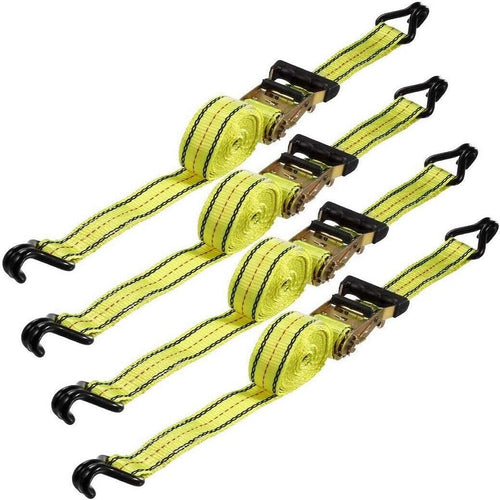
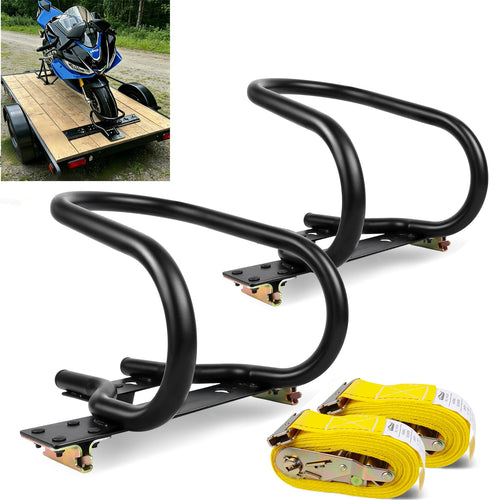
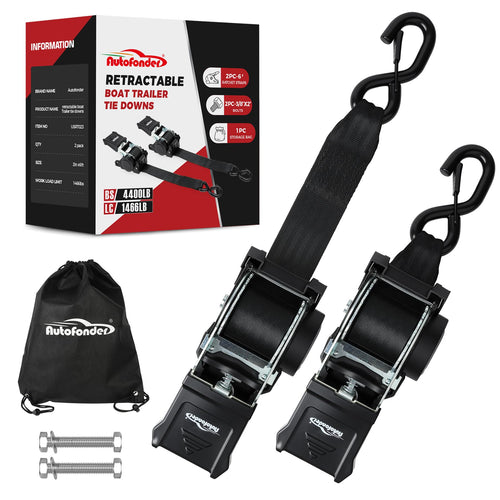
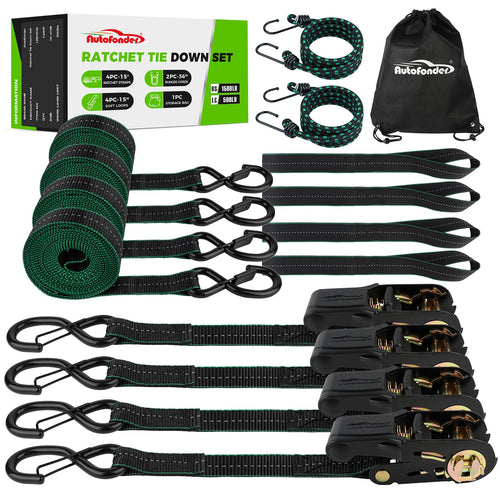
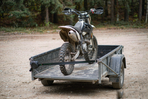
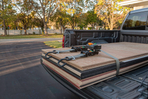
For a residential zero-turn mower weighing 400 to 800 lb, four 1 in self-storing ratchet straps rated 500 lb WLL each are the right size — the Autofonder NeatStrap 4-pack covers that class with more than double the federal 50% margin. Commercial 60-inch machines from 900 to 1,500 lb need the 2 in x 10 ft retractable ratchet straps rated 1,466 lb WLL per strap instead.
Key takeaways
- Match strap width to mower weight: 1 in for 400–800 lb, 2 in for 900 lb and up.
- A 1 in NeatStrap is rated 1,500 lb break strength and 500 lb working load limit.
- Strap the frame and axle — never over the deck, seat, or plastic panels.
- Four retractable ratchet straps at four corners stop rocking; two leave the nose free to yaw.
- Recheck tension at 50 miles; mower straps settle after the first bumps.
What Weight Class Is Your Zero-Turn Mower?
Size starts with a scale number, not a strap brand. Residential zero-turn mowers with 42- to 54-inch decks typically weigh 400 to 800 lb — a 42-inch entry model runs near 450 lb, while a 54-inch residential unit approaches 700 lb. Commercial machines with 60-inch or wider decks and fabricated frames climb from 900 lb to as much as 1,500 lb. Check the model plate or the manufacturer's spec sheet before you buy hardware; the number decides everything downstream.
That weight spread is why one strap size does not fit every mower. A 500 lb WLL strap set has plenty of margin for a 500 lb machine and almost none to spare for a 1,400 lb diesel unit, which is why the retractable ratchet strap line is split across 1 in and 2 in widths in the first place. Check the model plate or the manufacturer's spec sheet before you buy hardware; the number decides everything downstream.
How Do You Calculate the Strap Size for a Mower's Weight?
The benchmark most haulers use comes from 49 CFR 393.106(d): the aggregate working load limit of the tiedowns holding a load must be at least half of that load's weight, and each strap that runs from a vehicle anchor to the cargo counts at only half of its marked WLL. Part 393 governs commercial vehicles, but Autofonder uses the same 50% margin for consumer advice because it is the standard professionals are audited against.
Run the numbers for the two mower classes:
| Step | Residential 42–54 in deck | Commercial 60 in+ deck |
|---|---|---|
| Typical mower weight | 400–800 lb | 900–1,500 lb |
| 50% benchmark at 700 lb / 1,200 lb | 350 lb aggregate WLL | 600 lb aggregate WLL |
| WLL per 1 in NeatStrap | 500 lb | 500 lb |
| Counted per strap (anchor-to-cargo) | 250 lb | 250 lb |
| Aggregate with four 1 in straps | 1,000 lb — clears easily | 1,000 lb — clears 600, but thin margin |
| WLL per 2 in x 10 ft strap | 1,466 lb | 1,466 lb |
| Aggregate with four 2 in straps | — | 2,932 lb — clears with 5x margin |
The count minimum matters too: 49 CFR 393.110 requires at least two tiedowns for an article longer than 5 feet, which describes every zero-turn on the market. Four points remains the practical answer for a machine with an engine over the drive wheels, because two straps let the nose yaw on curves.
1 In or 2 In Retractable Ratchet Straps: Which Fits Your Mower?
| What you are asking | 1 in x 15 ft self-storing NeatStrap | 2 in x 10 ft retractable | 1 in x 12 ft soft-loop |
|---|---|---|---|
| Break strength per strap | 1,500 lb | 4,400 lb | 1,500 lb |
| Working load limit per strap | 500 lb | 1,466 lb | 500 lb |
| Aggregate with a 4-pack / pair | 2,000 lb (4 straps) | 2,932 lb (2 straps) | 2,000 lb (4 straps) |
| Hook type | Chromoly S-hook | Safety-latch S-hook | Soft loop, wrap-anywhere |
| Best mower class | 400–800 lb residential | 900–1,500 lb commercial | Painted-frame residential |
| Price | $49.99 (4-pack) | $69.99 (2-pack) | $79.99 (4-pack) |
| Excess webbing at setup | Winds onto the built-in spool | Winds into the housing | Loose tail to tie off |
For the 400 to 800 lb class, the Autofonder 1 in x 15 ft self-storing NeatStrap 4-pack is the size to buy. Fifteen feet reaches from a trailer stake pocket, under the mower, to the opposite rail on standard 77-inch-wide utility decks, and the Chromoly S-hooks seat into stake pockets or frame D-rings without adapters. The self-storing spool is the reason retractables suit mowers specifically: after tensioning, there is no loose webbing tail to flutter or catch grass in.
Step up to the 2 in x 10 ft retractable ratchet tie down straps when the mower weighs 900 lb or more, or when the haul crosses rough roads where narrow webbing saws. Two inches carries almost three times the working load and spreads pressure over a wider tire contact if you strap over the wheels.

How Do You Rig Four Retractable Ratchet Straps on a Zero-Turn Without Damaging the Deck?
- Drive the mower straight up the ramp and center it on the deck, then chock the trailer wheels and lower the jack before you leave the seat.
- Front pair: hook into the trailer D-rings or stake pockets ahead of the front casters, and run the webbing over the caster arms or around the front frame rails — not across the deck shell.
- Rear pair: anchor behind the rear tires and strap over the rear tire tread or around the frame, which is where the engine and hydro pumps mass sits.
- Tension each strap until it stops taking up, then one more click. Pull the webbing by hand afterward: a drum that yields needs reseating.
- Drive 50 miles and walk the trailer. Straps settle as tires flex and suspension bushes compress, so a recheck at that mark is standard practice for commercial drivers under 49 CFR 392.9(b) and a good habit for everyone.

When Is a Retractable Ratchet Strap the Wrong Tool for a Mower?
Retractable ratchet straps are consumer and light-commercial gear, and three mower scenarios call for something else:
- Commercial landscaping fleets under DOT rules. If the mower moves as part of a regulated commercial operation, verify each assembly's marked WLL against 393.106(d) and the tiedown counts in 393.110 — and for commercial flatbed work, standard 2 in or 4 in ratchet straps or winch straps are the appropriate hardware, not consumer retractable units.
- Low or no anchor points. A bare-deck utility trailer with no stake pockets or D-rings leaves an S-hook nothing to grip. The soft-loop 1 in x 12 ft set wraps around the frame rails instead.
- Faded or freshly painted frames. A steel hook ridden against fresh paint will chew it. The soft-loop set again, or the safety-lock S-hook model, reduces the risk.
A maintenance note for mowing season specifically: grass seeds and dust pack into the housing faster than highway grit does. Blow the housings out with compressed air after dusty jobs and rinse after any fertilizer spill — the full routine lives in our guide to keeping retractable ratchet straps from seizing up.
Bottom Line: Which Size, How Many, What Price?
For a 400 to 800 lb residential zero-turn, the answer is four Autofonder 1 in x 15 ft self-storing NeatStrap retractable ratchet straps — 1,500 lb break strength, 500 lb WLL each, $49.99 for the 4-pack — strapped to the frame and rechecked at 50 miles. For commercial machines 900 lb and up, move to two 2-packs of the 2 in x 10 ft retractable ratchet straps (1,466 lb WLL each, $139.98 total). Compare all widths in the ratchet strap collection, or see the same sizing method applied to a snowmobile and an ATV.
FAQ
Will the S-hooks scratch my mower's painted frame?
A hook resting under tension on painted sheet metal will chew through it over washboard roads. Hook into stake pockets, frame D-rings, or the axle itself — bare steel that does not care — or switch to a soft-loop strap that wraps the frame without any metal touching it.
Is it safe to trailer a zero-turn at highway speed with retractable ratchet straps?
Yes, within the weight class. Four 1 in straps at 500 lb WLL each provide 1,000 lb of counted capacity against a 350 lb benchmark for a 700 lb mower, and a seated ratchet pawl does not creep on its own. The failure mode is human: hooks that were never fully seated and drums that were never cranked tight. Rig correctly and recheck at 50 miles.
Can I strap over the mower deck instead of the frame?
No. The deck is stamped sheet metal hung on linkages, and it flexes — a strap tensioned across it will bow the shell or bend a chute. Strap the frame rails, the rear axle, or over the rear tires, which put force into structures designed to carry load.
What if it rains on the way home with the mower strapped down?
Polyester webbing loses almost nothing when wet, and the sealed housings on both strap sizes shrug off a soaking. The real risk is packing a wet strap away: retract it damp and the drum rusts. Let straps air dry uncoiled after a wet haul, then store as usual.
How tight is too tight on a mower tire?
If the tire visibly squats or the sidewall bulges, you have gone past the stop point. Strapping over the rear tires should take up slack and hold the tread firm — enough that you cannot lift the webbing by hand, not enough to deform the tire. Over-tensioning also loads the transmission idler, so back off a click if in doubt.