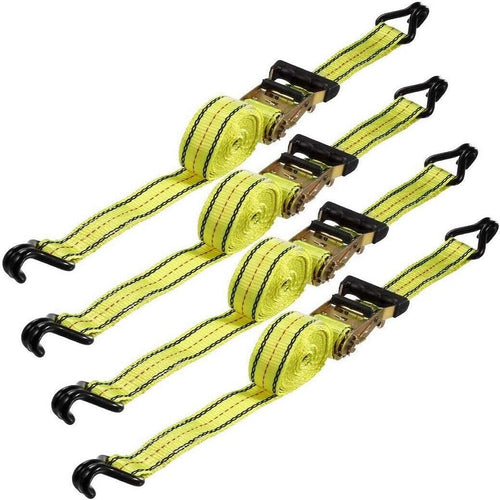
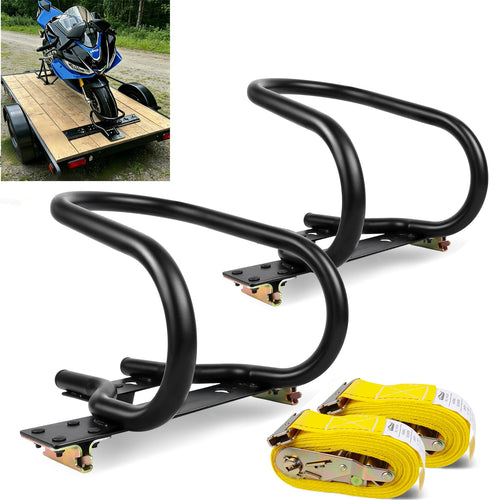
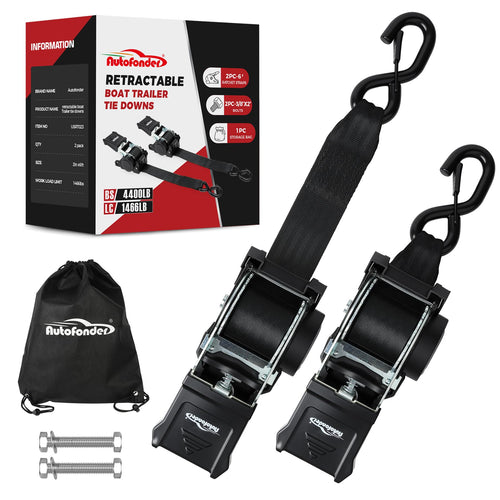
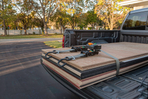
Two 2 in x 10 ft retractable ratchet straps rated at 1,466 lb working load limit (WLL) each are the right size for most jet ski trailers. A typical two-seat jet ski weighs 600 to 1,000 lb, and even under the conservative half-credit counting rule cargo inspectors use, two of those straps deliver roughly three times the holding power the load requires.
Key Takeaways
- Most jet skis weigh 600–1,000 lb; two 2 in x 10 ft retractable ratchet straps (1,466 lb WLL each) hold that with margin to spare.
- 1 in straps carry a 500 lb WLL — enough for a 400–500 lb lightweight PWC, tight for heavier three-seaters.
- Use 6 ft straps for short transom runs and 10 ft straps when you anchor to the trailer frame.
- Count only half of each strap's WLL when it runs from a trailer anchor to the craft — the same half-credit rule FMCSA applies to commercial loads.
- The trailer winch strap still owns the bow eye; retractables handle the stern and the bounce.
How Do You Match Strap Size to Your Jet Ski's Weight?
Start with the scale. Light two-seat runabouts weigh 400–550 lb. Mid-size three-seaters land between 600 and 800 lb, and loaded luxury models push 850–1,100 lb. Base your strap math on the number on the manufacturer's plate, not on a guess.
Then apply the half-credit rule. 49 CFR 393.106(d), the federal cargo securement rule, counts only half the WLL of each tiedown that runs from a vehicle anchor point to an anchor point on the cargo. Recreational trailers are not governed by that rule, but it is the most conservative, best-tested benchmark available — so copy it.
Here is the math for a 1,000 lb jet ski:
- Two 1 in straps (500 lb WLL each): 250 + 250 = 500 lb of aggregate holding power. That exactly meets the half-weight floor — zero margin left.
- Two 2 in x 10 ft retractable ratchet straps (1,466 lb WLL each): 733 + 733 = 1,466 lb aggregate. Nearly three times the floor.
That gap is why Autofonder 2 in x 10 ft retractable ratchet tie down straps — 4,400 lb break strength, 1,466 lb WLL, $69.99 for a 2-pack — are the sensible default for anything above a 550 lb craft.

Are 2-Inch Retractable Ratchet Straps Overkill for a Small PWC?
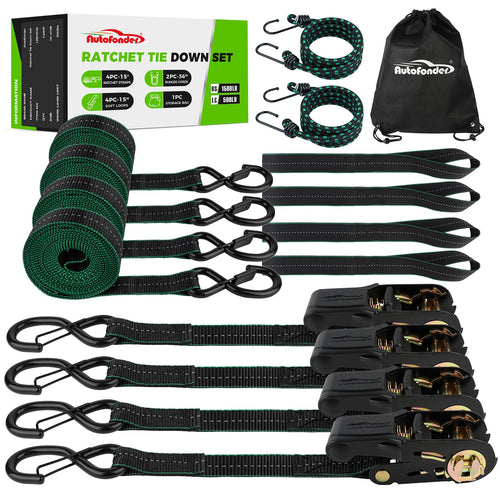
For a 400–500 lb lightweight model, no — 1 in webbing is genuinely adequate. Two 1 in x 12 ft retractable straps with soft loops (1,500 lb break strength, 500 lb WLL, $79.99) produce a 500 lb aggregate against a 250 lb requirement. Double the margin with half the hardware weight.
Two things push buyers back to 2 in anyway. First, pressure concentration: over a deck edge or rub rail on washboard roads, a wider 2 in band spreads the same force over roughly twice the contact area. Second, versatility — a 2 in pair that secures a jet ski on Friday also secures a 700 lb UTV on Sunday. If the jet ski is the only thing you tow, 1 in saves money. If the trailer sees mixed duty, 2 in earns its keep.
| Question | 1 in x 12 ft soft-loop set | 2 in x 10 ft retractable | 2 in x 6 ft transom pair |
|---|---|---|---|
| What craft weight does it suit? | 400–550 lb PWC | 600–1,100 lb jet ski or UTV | Bow-to-stern tie-downs on any size |
| What WLL do you get? | 500 lb per strap | 1,466 lb per strap | 1,466 lb per strap |
| What does a 2-pack cost? | $79.99 | $69.99 | $69.99 |
| Where do the straps anchor? | Wrapped around rails and frame | Frame crossmembers and D-rings | Stern eyes to trailer tail |
| How many do you need? | Two | Two | Two |
What Length Retractable Strap Reaches Your Trailer Frame?
Personal watercraft trailers are short — most are 12 to 15 ft bumper-pull singles — so length is an easier choice than for pickup beds:
- 6 ft retractable straps are cut for transom duty: stern gunwale eye to trailer tail. The 2 in x 6 ft transom pair carries the same 1,466 lb WLL at $69.99 and was designed around exactly that short run.
- 10 ft retractable straps reach frame crossmembers and mid-trailer D-rings when you want over-the-bow or side stabilization beyond the transom pair.
- 12 ft straps only make sense if you wrap around the craft or anchor far forward. Extra length just stacks outside the housing.
Order of operations matters: the winch strap owns the bow eye and forward restraint. Your retractable ratchet straps own the stern and the bounce. Our step-by-step jet ski tie-down walkthrough covers the full sequence.
Which Anchor Points Work Best on a Jet Ski Trailer?
Good anchors: factory D-rings, frame crossmembers, and rated tie points whose strength matches or exceeds the strap's WLL. Bad anchors: light-duty bumper bolts, plastic trim, and anything that flexes when you tug it.
Match the connector to the anchor. S-hooks snap into holes but can skate sideways on smooth rails. Soft loops wrap rails without scratching — the reason the 1 in soft-loop set is the usual pick on galvanized frames with fresh paint. Whichever you use, pull the finished rig hard by hand before you drive; any anchor that moves needs replacing, not re-tightening.
How Do You Count WLL the Way Inspectors Do?
Commercial inspectors total tie-down strength in three steps, a habit worth copying even for a weekend trailer:
- Half the WLL of each strap running from a trailer anchor to an anchor on the craft.
- Half the WLL of each strap that passes over the craft and returns to the same side.
- Full WLL only for straps that cross over and attach to the opposite side.
The same federal subpart also sets minimum tiedown counts by cargo length and weight — two tiedowns for most articles longer than 5 ft — and requires anchor hardware at least as strong as the strap. If you ever move up to hauling equipment commercially, the standard changes: verify the full assembly's rated WLL against § 393.106(d) and switch to standard 2 in or 4 in ratchet straps or winch straps rated for commercial flatbed securement. Consumer-grade retractables are built for personal trailers, not for-hire flatbed work.
When Should You Not Use Retractable Ratchet Straps?
Honest limits, stated plainly:
- Fixed length. A 6 ft housing cannot stretch to a far anchor the way a 27 ft standard strap can. Measure the run before you buy.
- Abrasive environments. Sand and grit that migrate into the spring chamber make retraction sticky over time. If your hauls involve mud, follow the mud-cleaning routine before storing the straps.
- Lower WLL per width. A same-width standard ratchet strap generally rates higher, because the retractable mechanism — not the webbing — is the bottleneck.
- Commercial flatbed securement. For-hire work needs assembly-rated WLL verification and standard ratchet or winch straps.
Bottom Line: Which Size Should You Buy?
For any jet ski in the 600–1,100 lb class, buy two Autofonder 2 in x 10 ft retractable ratchet straps (4,400 lb break strength, 1,466 lb WLL, $69.99), anchor them to the trailer frame, and add the 6 ft transom pair ($69.99) if your stern tie-downs are short. Light-craft-only owners can save with the 1 in soft-loop set at $79.99. Browse the full ratchet strap collection to match hardware to your anchors.

Frequently Asked Questions
Will a jet ski come loose on the highway with retractable ratchet straps?
Not if the math and the anchors are right. Two 2 in straps with a 1,466 lb WLL hold a 1,000 lb craft with nearly three times the required margin. The internal spring keeps webbing snug as the load settles — a quiet advantage of the retractable design. Still, walk the rig after the first 10 miles of rough road and check again at each fuel stop, the same three-check discipline commercial drivers follow. More on tension in our boat trailer tightness guide.
Can retractable ratchet straps scratch a jet ski hull?
The webbing will not; hardware can. Keep metal hooks off gelcoat, deck edges, and the rub rail — pad them or route them to the trailer frame instead. If your only clean anchor sits against painted or plastic surfaces, wrap a soft loop around the rail first. Aim contact pressure at the trailer structure, never at the hull.
Can I leave retractable ratchet straps tensioned on the trailer in the rain?
Tension is fine; storage is not. Polyester webbing shrugs off rain, but a wet strap retracted into its housing dries slowly and can leave mineral stains while grit pastes up inside the spring chamber. After a wet haul, extend the straps, let them air-dry in shade for a day, then retract and store.
Do I still need the trailer winch strap if I use retractable ratchet straps?
Yes. The winch strap to the bow eye provides forward restraint and keeps the hull seated on the bow roller; the retractable ratchet straps handle rearward and lateral movement. That front-plus-rear arrangement mirrors the two-direction logic the federal rules expect for vehicles in transit — and the winch is already on the trailer.
How tight is tight enough on a jet ski trailer?
Snug, not crushing. The hull should not lift off the bow roller when you push down at the stern, and the webbing should not deform seats or soft trim. Over-tensioning buys nothing on a 700 lb craft — it only risks dented trim and a warped roller stop.