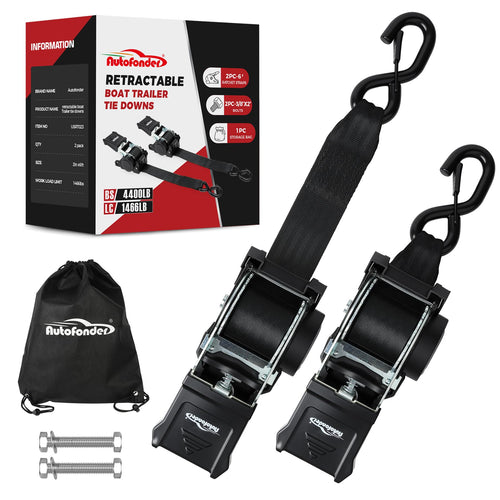
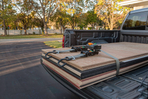
Two retractable ratchet straps — one on each stern eye — are all a single-place jet ski trailer needs. A pair of 2-inch x 6-foot retractable boat trailer tie downs rated at 1,466 lb working load limit and 4,400 lb break strength bolts permanently to the trailer frame and tensions each side in under a minute — already mounted, already sized, never tangled.
Key Takeaways
- Two straps minimum, one per stern eye; add a bow strap for long highway trips.
- 2-inch webbing with a 1,466 lb WLL covers any production personal watercraft — most weigh 600 to 1,100 pounds.
- Bolt the housings to the trailer frame once; every hookup after that takes about 60 seconds.
- A short 6-foot strap matches the transom-to-frame distance on most single-place trailers better than a 10-footer.
- Re-check tension at your first stop, the same habit commercial drivers follow at 50 miles under 49 CFR 392.9(b).
How Many Retractable Ratchet Straps Does a Jet Ski Need?
Two — one hooked to each stern eye. Personal watercraft weigh between roughly 600 and 1,100 pounds, and the working rule is that the combined working load limit of your tie downs should reach at least half the craft's weight. That 50% standard comes straight from FMCSA's commercial cargo rule, 49 CFR 393.106(d) — a good benchmark even for weekend hauling.
Counted the way the regulation does — half the marked WLL for each strap that runs from a vehicle anchor point to the cargo — a pair of 1,466 lb WLL retractable ratchet straps still delivers 1,466 lb of aggregate working load limit. That is comfortably more than half the weight of any personal watercraft on the market.
A third strap over the bow is optional. It helps on long interstate runs, where hull slap can work a stern hook loose, but for launch-ramp duty two stern straps plus the trailer's winch strap on the bow eye are enough.
Where Should the Straps Anchor on a Jet Ski Trailer?
A transom tie down is a short, steep line: housing low on the trailer's rear cross member, hook up to the rubber grab eye on each corner of the hull. The straighter and shorter the line, the less the hull can rock side to side on the road.
That geometry is exactly why length matters. On most single-place trailers the distance from cross member to stern eye is 4 to 6 feet. A 2" x 6' retractable boat trailer tie down is built for that run — the housing bolts through the frame with the included 3/8-inch hardware, and the black S hook clips straight into the stern eye. The 2-pack also ships with a drawstring storage bag for the winter.
The bow eye stays on the winch strap. Do not replace the winch with a ratchet strap: the winch controls loading and unloading, the transom tie downs control the ride.

What Size Retractable Ratchet Strap Fits a Personal Watercraft?
Match the strap to the distance and the weight, not to the biggest number on the shelf:
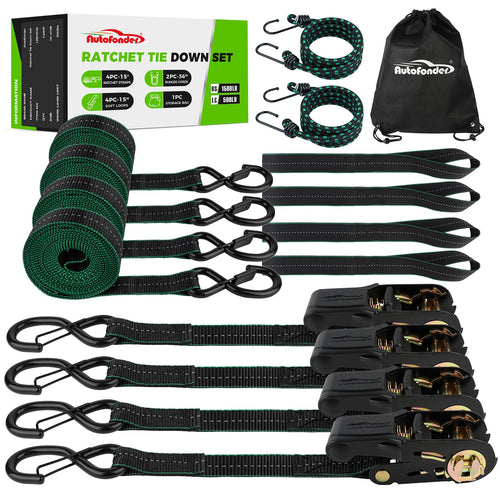
| Question | 1in x 12ft soft loops (USRT019) | 2in x 6ft transom (USRT023) | 2in x 10ft (USRT022) |
|---|---|---|---|
| Break strength per strap? | 1,500 lb | 4,400 lb | 4,400 lb |
| Working load limit? | 500 lb | 1,466 lb | 1,466 lb |
| How far is your anchor run? | Long runs, truck beds | Transom to trailer frame | Mid-length runs, truck beds |
| Best carrier? | Kayaks, ATVs, mowers | Jet ski and boat trailers | UTVs, garden tractors |
| Price? | $79.99 (4-pack) | $69.99 (2-pack) | $69.99 (2-pack) |
The 2-inch webbing earns its width here in two ways. It stretches less than 1-inch webbing under sustained highway vibration, and it spreads the load across more of the rubber stern eye instead of concentrating it in a thin band. The 2" x 10' retractable ratchet strap carries the same 1,466 lb WLL, but the extra 4 feet of webbing just piles up outside the housing on a single-place PWC trailer.
How Do You Install and Tension Them Step by Step?
- Park on level ground, chock the trailer wheels, and confirm the jet ski is seated on the bunks with the winch strap snug.
- Bolt one retractable housing to each side of the rear cross member, keeping the webbing exit facing the hull.
- Extend the strap, clip the S hook into the stern eye, and pull out only the slack — the line should run straight with no twists.
- Crank the ratchet handle until the strap is snug, then add two to three more strokes. The hull should not compress; the bunks carry the weight, the straps stop movement.
- Grab the stern rail and shake. The hull and trailer should move as one unit with no visible strap stretch.
- Tension the second side the same way so the craft stays centered on the bunks.

Safety note: the internal spring rewinds the webbing fast once you release the lock. Keep fingers clear of the housing mouth whenever the strap is under tension.
When Should You Not Use Retractable Ratchet Straps?
Honest limits, because a retractable is not always the right tool:
- Fixed length. The spool holds exactly 6 feet. If your cross member sits more than about 5 feet from the stern eye, buy the 10-foot version instead — stretching a 6-foot strap to reach is not an option.
- No joining or lengthening. You cannot splice webbing through the housing the way you can re-rig a standard ratchet strap.
- Sand and grit. Beach launches blow sand straight into the housing gap. Rinse with low-pressure water after salty or sandy trips — never a pressure washer, never oil.
- Commercial flatbed duty. These are consumer and light-commercial straps. If you deliver PWCs for a living, verify the marked WLL of the whole assembly against 393.106(d) for your load — commercial flatbed haulers should run standard 2-inch or 4-inch ratchet straps or winch straps instead.
How Do You Check Your Jet Ski Tie Downs Before You Drive?
Give each strap a 30-second inspection before the season's first trip and a 10-second glance after every launch:
- Webbing: no cuts, frayed yarn, or glazing; stitching at the hook intact.
- Housing: no cracks, rewind still snappy.
- Hook: latch closes fully and the eye it clips into is not cracked rubber.
- Hardware: cross-member bolts tight.
On the road, stop within your first 50 miles and re-crank anything that has relaxed — the re-examination schedule commercial drivers follow under 392.9(b). Saltwater riders should rinse the housings and webbing with fresh water and let them shade-dry before retracting; sun-baked storage is what kills polyester webbing. For a deeper maintenance walkthrough, see why retractable ratchet straps stop retracting.
Frequently Asked Questions
Will retractable ratchet straps scratch my jet ski's hull?
Not if they anchor to hardware, not to paint. The S hooks clip into metal or rubber tie-down eyes, so the hook never touches gelcoat. The 2-inch webbing is also wide enough that it does not dig into rubber eyes the way a 1-inch strap can. For painted or finished surfaces anywhere in the rig, the yarn-dyed zero color transfer version eliminates dye bleed onto white hulls and light plastics.
Can I leave retractable ratchet straps on the trailer in the rain?
Yes. The housings seal against ordinary rain, and polyester webbing does not rot or stretch the way nylon does when wet. What shortens strap life is salt and sun, so rinse after saltwater use, let the webbing dry in the shade, and store it retracted so grit stays out of the spool.
How many straps do I need for a two-place jet ski trailer?
Four — one per stern eye on each watercraft — with the same 1,466 lb WLL per strap. Two riders hauling two skis still get away with one 2-pack per ski, mounted in pairs. Add bow straps only for sustained highway speeds above roughly 65 mph.
Are retractable ratchet straps legal for commercial PWC delivery?
For a commercial operation, compliance is decided by the numbers, not the strap style. The aggregate working load limit of all tie downs must be at least half the load weight per 393.106(d), using each component's marked WLL. Autofonder's retractable tie downs carry a marked 1,466 lb WLL, but for regular commercial flatbed transport, standard 2-inch or 4-inch ratchet straps or winch straps remain the appropriate choice.
Do the straps loosen from highway vibration?
The ratchet pawl holds tension as long as it is fully engaged, which is why the crank must click past the lock point — not just feel snug. What actually loosens a load is hull settling and bunk flex in the first miles. That is why the first-stop recheck matters more than anything you do in the driveway.
Bottom Line
For a single-place jet ski trailer, buy the Autofonder 2" x 6' retractable boat trailer tie downs — $69.99 for a 2-pack with 1,466 lb WLL per strap — mount one housing per stern eye, leave the bow eye to the winch, and re-crank at your first stop. After the one-time install, securing your PWC takes about a minute per side, every trip. See how the same hardware handles two wheels in our retractable vs standard ratchet strap comparison for dirt bikes, check the 1-inch soft-loop kit for kayaks, or browse the full ratchet strap collection. For transom-specific geometry, read which retractable tie down straps fit a boat trailer transom.