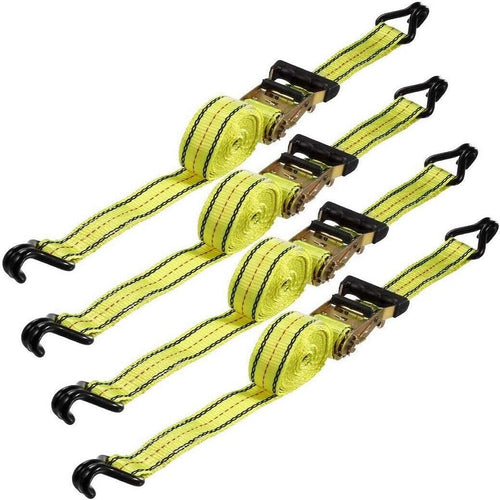
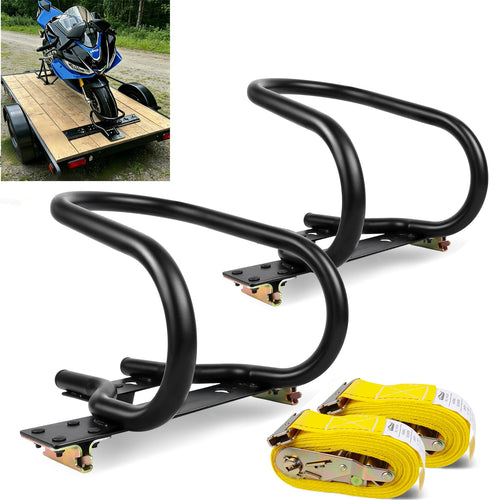
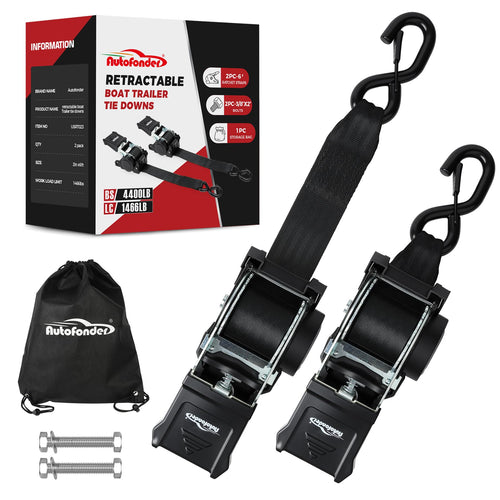
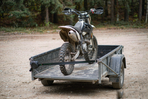
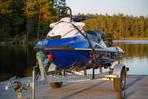
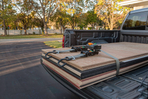
For most dirt bike riders, retractable ratchet straps win: a 1-inch x 15-foot self-storing strap with a 500 lb working load limit rigs a bike-ready trailer in about 30 seconds per strap, with nothing to tangle in the trailer box. Standard ratchets keep the edge on tension control and adjustable length — but for weekend riding, speed and tidiness settle it.
Key Takeaways
- Use two retractable ratchet straps per bike minimum; four is the standard for highway speeds.
- 1-inch webbing rated 500 lb WLL (1,500 lb break strength) is plenty for a 200 to 250 lb dirt bike.
- Soft loops around the handlebar or triple clamp protect fork seals and anodizing.
- Retractables store their own webbing — no loose tails flying at 70 mph.
- Choose standard ratchets only when you need adjustable length or maximum tension control.
Why Do Dirt Bikes Need Softer Tie-Downs Than ATVs?
A dirt bike's front end is its most fragile cargo point. Compressing the forks is normal and healthy — the standard practice is to cinch until the front suspension compresses about 1 to 2 inches — but the strap must never clamp directly onto the fork tubes, and a hard hook must never rest against the anodized triple clamp or painted frame.
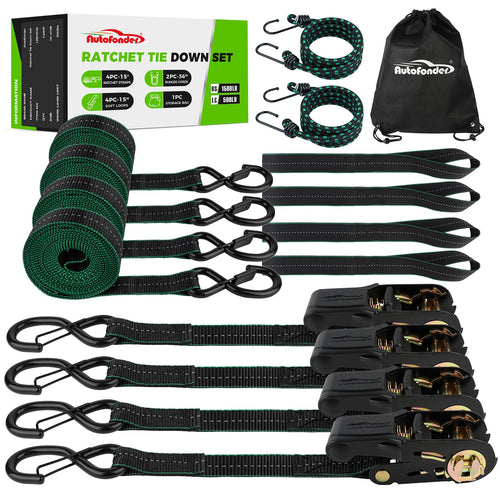
That is where soft loops earn their keep: wrapped around the handlebar crossbar or triple clamp, they give the hook a polyester-only grabbing surface. The Autofonder NeatStrap safety-lock kit pairs each 1-inch x 15-foot retractable strap with its own soft loops, so the webbing-to-fork contact is always fabric on metal, never steel on finish. Hook to the trailer's side rails, never to the bike's footpegs, levers, or plastics.
What Is the Real Difference Between Retractable and Standard Ratchet Straps?
Both types tension the same way — a ratchet gear and pawl — but they diverge everywhere else:
| Question | Retractable (self-storing) | Standard ratchet |
|---|---|---|
| Setup time per strap? | About 30 seconds | 2–3 minutes, plus coiling tails after |
| Length adjustment? | Fixed (15 ft on a NeatStrap) | Any webbing length, re-riggable |
| Loose tail flying at highway speed? | None — webbing rewinds into the housing | Requires Velcro or knot management |
| Storage in the trailer box? | Self-storing, tangle-free | Straps nest and tangle |
| Tension control? | Ratchet clicks, fixed spool | Finer control, easier to back off |
| Same-width WLL? | 500 lb at 1 inch (marked) | Depends on the marked assembly rating |
The last row matters most. Working load limit is a property of the whole marked assembly, not of webbing width, so compare labels rather than shelf claims. The trade-off in practice: a standard 1-inch ratchet strap can be re-rigged around awkward anchor points, while a retractable trades that flexibility for a permanently sized, always-ready line.

Which Width and Rating Should You Use on a Dirt Bike?
Dirt bikes are light — most modern machines weigh 200 to 250 pounds — so the rating is rarely the constraint; the geometry is. For a single bike on a utility trailer, the 1-inch x 15-foot length is the sweet spot for retractable ratchet straps: long enough to reach from the handlebar down to rail-mounted D-rings at an angle, short enough that the housing stores the tail cleanly.
| Question | NeatStrap safety lock (USRT014) | Self-storing NeatStrap (USRT010) | 2in x 10ft (USRT022) |
|---|---|---|---|
| Width and length? | 1 in x 15 ft | 1 in x 15 ft | 2 in x 10 ft |
| Break strength? | 1,500 lb | 1,500 lb | 4,400 lb |
| Working load limit? | 500 lb | 500 lb | 1,466 lb |
| Hook style? | Soft loops + safety-lock S hooks | Chromoly S hooks | Heavy 2-in hardware |
| Pack and price? | 4-pack, $37.99 | 4-pack, $49.99 | 2-pack, $69.99 |
| Best carrier? | Dirt bikes, e-bikes, cargo boxes | Motos, moving boxes, appliances | UTVs, mowers, mid-size cargo |
A 2-inch x 10-foot retractable ratchet strap is overkill for one 230-pound bike, but it is the right call when the same trailer hauls a riding mower or a UTV on alternating weekends.
How Many Retractable Ratchet Straps Does a Dirt Bike Need?
Two minimum, four for peace of mind. A dirt bike is longer than 5 feet, so the federal minimum-count table in 49 CFR 393.110(b) — FMCSA's commercial minimum, which smart haulers borrow for their own trailers — calls for at least two tiedowns on an article over 5 feet long, one toward the front and one toward the rear.
The front strap compresses the forks 1 to 2 inches and does most of the braking-load work. The rear strap stops the bike from pitching forward and hopping. Add a second pair of retractable ratchet straps in an X-pattern over the rear swingarm for long interstate runs, a washboard fire road approach, or a bike carrying extra fuel weight up high.
When Should You Not Use Retractable Ratchet Straps?
Retractables have honest limits, and knowing them is what keeps a load safe:
- Fixed 15-foot length. If your anchor points demand a longer run, a retractable cannot be lengthened or spliced — a standard ratchet strap is the flexible tool.
- Sandy or muddy anchor zones. Grit that enters the housing eventually stalls the spool. If your staging area is a sand pit, standard straps that can be shaken out and re-coiled are easier to keep clean.
- Maximum-tension cargo. Cargo that must be crushed tight against a bulkhead wants the sustained, re-crankable tension of a standard ratchet.
- Commercial flatbed work. Retractables here are consumer and light-commercial gear. If you haul for hire on a flatbed, verify the whole assembly's marked WLL against the 393.106(d) aggregate rule; commercial flatbed operators should run standard 2-inch or 4-inch ratchet straps or winch straps.

How Do You Rig a Dirt Bike Step by Step?
- Load the bike into a wheel chock or against the trailer's front rail, in gear, with the sidestand up.
- Wrap a soft loop around the handlebar crossbar or the left triple clamp — never the fork tubes or levers.
- Clip the safety-lock S hook to the soft loop, run the webbing forward and down at roughly 45 degrees, and clip the second hook to the trailer rail or D-ring.
- Crank until the front suspension compresses 1 to 2 inches, then back off if the forks top out.
- Repeat on the rear: a soft loop around the swingarm, strap angled down and back to the opposite rail.
- Shake the bars and the rear fender. The bike and trailer should move as one unit.
- Stop within your first 50 miles and re-check — the same first-stop recheck 49 CFR 392.9(b) requires of commercial drivers.
Frequently Asked Questions
Can a retractable ratchet strap come loose on the highway?
Not if the pawl is fully engaged and the hooks are seated. The ratchet holds tension mechanically once it clicks past the lock point, and the spring-loaded safety latch on each S hook keeps the hook from bouncing out of a D-ring on washboard roads. What actually loosens bikes is initial settling, which is why the 50-mile recheck matters more than cranking harder in the driveway.
Will retractable ratchet straps damage my fork seals or scratch the anodizing?
Not when the strap pulls through a soft loop wrapped around the handlebar crossbar or triple clamp, and the compression stays in the 1-to-2-inch range. Damage comes from three specific mistakes: clamping webbing directly on the fork tubes, letting a hard hook rest against finished aluminum, and over-compressing until the forks bottom and the seals take side load. Soft loops plus moderate tension avoid all three.
How tight is too tight on a dirt bike tie down?
If the front forks have topped out, the bike sits nose-down, or the handlebars resist turning back to center, you have gone past useful tension. Two clicks past snug-to-1-inch compression is the target. Over-tightening does not add security on a 230-pound bike — it just loads the seals and the chock for the whole ride.
Do I still need a wheel chock with four straps?
Yes. Straps control the bike's movement; the chock controls the front wheel's steering flop, which is what lets a bike walk sideways in the bed. A chock plus two or four straps is the standard setup; straps alone let the front wheel pivot and the bars lever against the tank.
Will blue webbing stain my white plastics or a painted trailer deck?
Dye transfer happens when wet webbing sits against light finishes, and it is a real issue with cheap dyed straps. Autofonder addresses it with a yarn-dyed retractable strap woven from pre-colored yarn that transfers zero color, even wet — the same option that protects white boat hulls and truck beds. For dirt bike plastics, soft loops at the contact points already keep webbing off finished surfaces.
Bottom Line
Buy the Autofonder NeatStrap safety-lock kit — four 1-inch x 15-foot retractable ratchet straps with soft loops and safety-lock S hooks, 500 lb WLL each, $37.99 for the 4-pack — run two straps per bike and four for highway trips, compress the forks 1 to 2 inches, and re-check at your first stop. Keep standard ratchet straps on hand only if your anchor points change week to week. For storage and maintenance details, see why retractable ratchet straps stop retracting, and for other two-wheel rigs read how many retractable ratchet straps a kayak needs or how to tie down a jet ski on a trailer. The complete line lives in the ratchet strap collection, and surface-protection details are in do retractable ratchet straps stain truck beds and boat hulls.