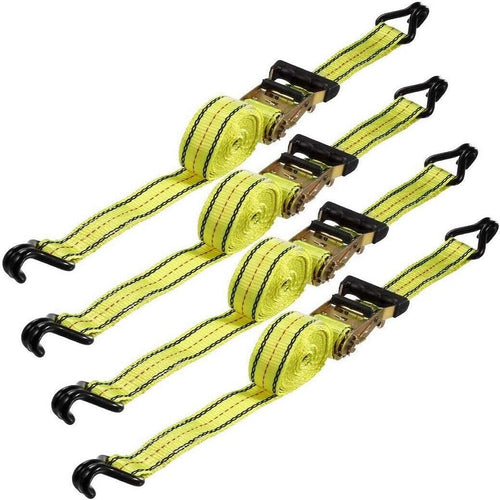
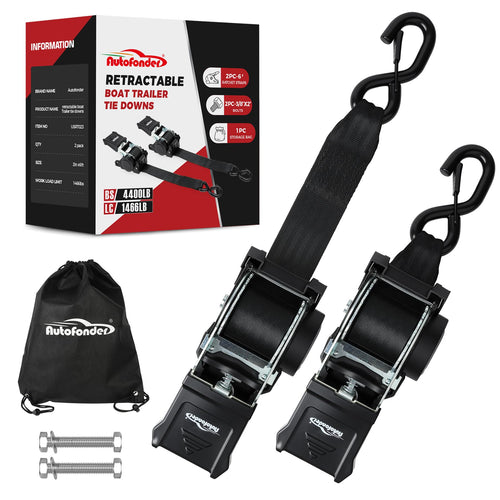
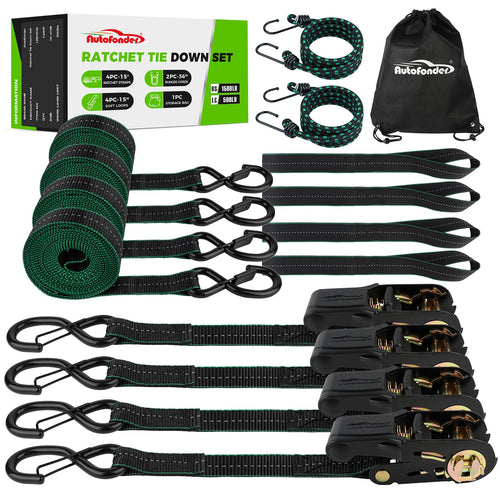
Tight enough that you cannot lift the webbing off the hull by hand — usually two to four full strokes of the handle on a 2-inch retractable ratchet strap rated at 1,466 lb working load limit. The webbing should press firmly against the gelcoat without visibly flexing the hull, and every strap should be rechecked within the first 50 miles of towing.
Key Takeaways
- Stop tensioning when the webbing will not lift off the hull by hand; extra strokes add hull stress, not holding power.
- Under 49 CFR 393.106(d), the combined WLL of your tie-downs should be at least half the cargo weight.
- A retractable ratchet strap anchored over the hull back to the same side counts as half its WLL — 733 lb of a 1,466 lb strap.
- Rinse the ratchet housings with fresh water after every saltwater launch.
- Boats longer than 10 feet need at least two tie-downs under the federal baseline, plus one more for each additional 10 feet.
How Tight Is Tight Enough on a Fiberglass Hull?
A boat is not a crate of tools. The hull is a molded shell, and the straps work against a surface that flexes. The correct stop point is firm contact: grab the webbing over the stern and pull upward. If you can raise it off the gelcoat and see daylight underneath, the strap needs another stroke or two. If the hull visibly dimples or the chine rails creak, you have gone one stroke too far.
Two full strokes on the 2-inch Autofonder retractable ratchet straps typically take up 4 to 6 inches of slack and produce roughly 300 to 400 lb of tension — enough to keep a 1,000 to 2,000 lb boat from shifting on its trailer without stressing the transom. The strap does not need to crush anything. It needs to remove the play between hull and trailer bunks so the whole package moves as one unit.
The reason tension discipline matters: a ratchet mechanism keeps every increment you crank, including the harmful ones. Unlike a cam buckle that slips under overload, a retractable ratchet strap will hold 800 lb of clamping force against a hull that was designed to ride on bunks, not to be squeezed. Firm, not crushed, is the standard.
Where Should Retractable Straps Attach on a Boat Trailer?
Three anchor zones do the real work:
- Transom tie-downs. Stainless eyes on both sides of the transom connect to the trailer frame near the rear crossmember. This is the job the 2-inch × 6-foot retractable boat trailer tie-down straps were built for — the short strap keeps the housing inside the frame rail and the S-hook reaches the transom eye without excess webbing.
- Bow eye. The winch handles forward load, but a second retractable ratchet strap to the bow eye backs up the winch if the hook or webbing fails.
- Stern tiedowns over the hull. On larger boats, straps run from one frame rail, over the stern, to the opposite rail — the crossing route that earns full WLL credit.
Keep every hook on metal. A hook resting on gelcoat will grind a quarter-mile of highway into a permanent scar. If your hull is white or lightly colored, the yarn-dyed zero color-transfer retractable straps eliminate the dye-bleed risk that standard black webbing carries in hot weather.
How Does the 50-Percent WLL Rule Apply to a Boat and Trailer?
Federal cargo rules in 49 CFR Part 393 apply to commercial motor vehicles, not a family towing to the lake on a weekend. But the math in 393.106(d) is the accepted benchmark for any trailer, and it is easy to apply:
- The combined working load limit of your tie-downs must be at least half the weight of the boat.
- A strap that runs from the trailer, over the hull, and hooks back on the same side counts only half its WLL: 733 lb of a 1,466 lb strap.
- A strap that crosses over the hull and hooks to the opposite side counts its full WLL: 1,466 lb.
Worked example: a 2,900-lb center console needs at least 1,450 lb of aggregate WLL. Two transom retractable ratchet straps routed over the stern to the same side deliver 2 × 733 = 1,466 lb — just enough. Cross them to the opposite rails and the same two straps deliver 2,932 lb, double the requirement. One routing change doubles your margin at zero cost.
Counting for retractable ratchet straps also has a length rule. Under 49 CFR 393.110, an article longer than 10 feet needs two tie-downs, plus one more for every additional 10 feet — so a 22-foot boat needs three. Commercial haulers must also re-inspect within the first 50 miles and then every 3 hours or 150 miles under 392.9(b); weekend towers benefit from exactly the same habit, because hull bounce loosens straps fastest in the first hour. If you move boats commercially on a flatbed, verify the marked assembly WLL against 393.106(d) and use standard 2-inch or 4-inch ratchet straps or winch straps — consumer-grade retractables are not flatbed equipment.
1-Inch or 2-Inch Retractable Ratchet Straps for Your Boat Trailer?

The width of your retractable ratchet straps decides the working load limit, and the length decides where the strap can reach.
| Your question | 1 in × 12 ft (4-pack) | 2 in × 10 ft (2-pack) | 2 in × 6 ft transom (2-pack) |
|---|---|---|---|
| How much can each strap hold? | 500 lb WLL (1,500 lb break strength) | 1,466 lb WLL (4,400 lb break strength) | 1,466 lb WLL (4,400 lb break strength) |
| What boat size fits? | PWCs, jon boats, inflatables up to about 1,500 lb | Boats up to about 3,000 lb | Boats up to about 3,000 lb at the stern |
| Where does it reach? | Full hull wraps and bow ties | Over-the-stern runs on wide beams | Transom eye to frame rail, 6-ft runs |
| What comes in the pack? | 4 straps | 2 straps | 2 straps |
| What does it cost? | $79.99 | $69.99 | $69.99 |
For most trailerable boats, the winning setup is the 2-inch × 6-foot pair at the transom plus one longer strap at the bow. The 1-inch four-pack earns its place on a PWC trailer, where 500 lb per strap comfortably covers an 800-lb ski with margin to spare.
When Should You Not Use Retractable Ratchet Straps on a Boat?
Honest limits, because a strap that is wrong for the job is dangerous at 65 mph:
- Rough-water hauls with tall freeboard. A self-storing spool holds a fixed webbing length. If your anchoring geometry needs a long wrap around a bow rail, a standard strap you can feed by hand is more adaptable.
- Commercial flatbed boat transport. Verification against the assembly's marked WLL is mandatory, and the accepted tools are standard 2-inch/4-inch ratchet straps or winch straps.
- Damaged or salt-frozen housings. If the spool grinds, retracts slowly, or the pawl skips, retire the strap. A boat at 65 mph multiplies any strap defect into a road hazard.
- Loads above 3,000 lb on the stern alone. Two 2-inch retractables top out at 2,932 lb of same-side aggregate. Heavier hulls need the crossing route, more straps, or standard hardware.
How Do You Keep Retractable Straps Alive After Saltwater?
Salt is the only real enemy these housings have. Rinse each housing and hook in fresh water after every launch — a garden sprayer at the ramp takes 30 seconds. Then let the straps dry fully extended, uncoiled, in shade; stowing wet webbing in a sealed housing is how mildew and spring corrosion start. Cycle the handle a few times once dry to confirm the pawl still clicks crisply. Boat trailers repeat this cycle dozens of times a season, and a rinsed set of retractable ratchet straps routinely outlasts three seasons of unrinsed ones.

Bottom Line
Set each strap until the webbing will not lift off the hull, route transom straps across to the opposite rail to double your counted WLL, and recheck at 50 miles. For boats up to about 3,000 lb, the 2-inch retractable ratchet straps in the Autofonder lineup — the 6-foot transom pair at $69.99 or the 10-foot pair for wider beams — cover the job with 1,466 lb WLL per strap. For more hull-specific rigging, see our guide to retractable tie-downs for a boat trailer transom or learn how to strap down sheet goods and lumber in a pickup bed with the same strap family.