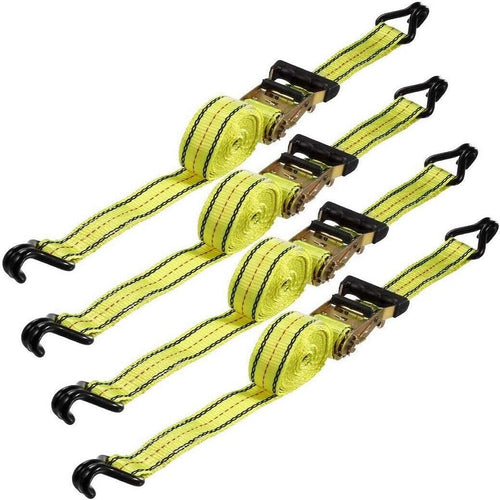
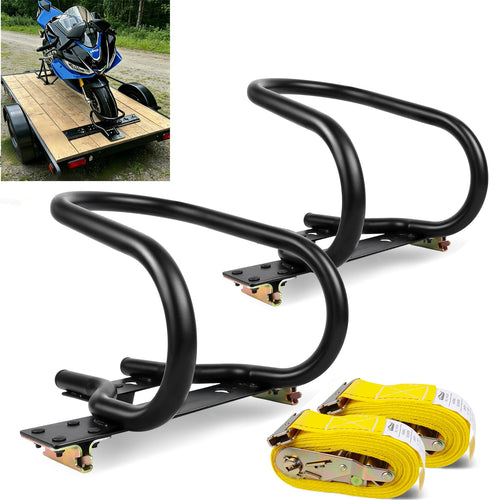
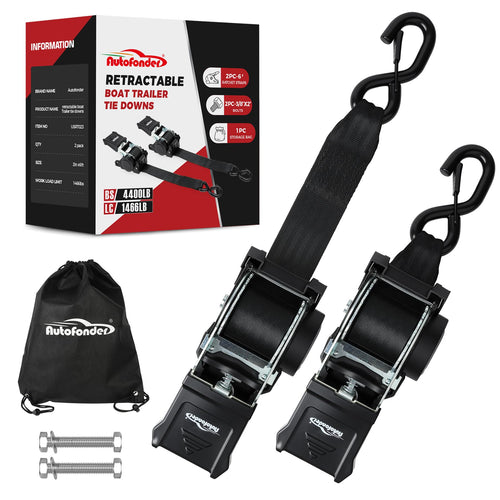
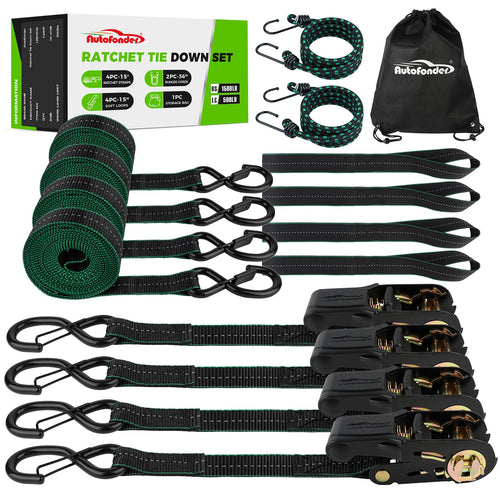
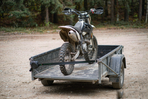
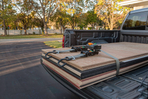
Four: two 2 in retractable ratchet straps over the front skis and two over the rear tunnel edges. A modern trail sled weighs 450 to 650 lb, and four 2 in x 10 ft retractable ratchet straps supply 5,864 lb of combined working load limit — nearly ten times the 300 lb minimum a 600 lb sled needs at the federal 50% benchmark.
Key takeaways
- Four straps, four corners: front skis in front, rear tunnel or running-board edges behind.
- Each 2 in x 10 ft strap carries a 4,400 lb break strength and a 1,466 lb WLL.
- Two 2-packs cost $139.98 in total and rig in about five minutes.
- The federal 50% rule sets the floor: strap WLL must total at least half the sled's weight.
- Recheck tension at 50 miles — webbing settles after the first bumps.
Why Four Retractable Ratchet Straps Instead of Two?
A snowmobile is an awkward subject for tie-down math. It runs 9 to 12 feet long, it rolls on two skis and a track instead of sitting flat, and its suspension is built to travel. Two straps over the middle of the machine will stop it from tipping in a lane change, but they leave the nose free to yaw and the tail free to hop on washboard roads.
Splitting the work across four points fixes both problems. The front pair controls the skis, which is where most steering-force shock travels into the straps. The rear pair pins the tunnel, so the back of the sled cannot bounce or walk sideways. This also matches the commercial counting method in 49 CFR 393.110: an unblocked article longer than 5 feet but no longer than 10 feet needs at least two tiedowns, and anything longer than 10 feet needs two plus one more for each extra 10 feet or fraction of it. A 12-foot sled crosses that second threshold — four points is the number professional haulers settle on, and it costs you nothing extra in time.
How Do You Rig a Four-Point Snowmobile Setup With Retractable Ratchet Straps?
Rigging a sled takes about five minutes with a pair of 2 in x 10 ft retractable ratchet tie down straps:
- Load the sled centered on the deck, nose toward the trailer tongue, and lower the jack foot or chock the trailer wheels first.
- Front pair: hook into the trailer's D-rings or stake pockets ahead of the skis, run the webbing over the ski saddle or through the ski loop, and bring the housing back down to the rail. Keep webbing away from sharp ski carbides.
- Rear pair: anchor behind the track and run the webbing over the tunnel edge or a running-board support — never across the seat, hood, or plastic panels.
- Tension each strap by pulling the webbing taut and cranking until the drum stops taking up. A 600 lb sled needs firm contact, not suspension-crushing force; the tires on a mower might squat, but a sled should not visibly compress its skid frame.
- Drive 50 miles, stop, and pull each webbing. Federal drivers re-inspect at that mark under 49 CFR 392.9(b) because straps settle after the first bumps, and the same habit protects a private hauler just as well.

What Does the 50 Percent Rule Mean for a 600 lb Sled?
Under 49 CFR 393.106(d), the aggregate working load limit of the tiedowns holding an article must be at least one-half of that article's weight, and a strap that runs from a vehicle anchor to the cargo counts at only half of its marked WLL. The math for a 600 lb sled:
| Step | Number |
|---|---|
| Sled weight, typical trail model | 450–650 lb |
| 50% benchmark for a 600 lb sled | 300 lb aggregate WLL |
| Marked WLL of one 2 in x 10 ft strap | 1,466 lb |
| Counted per strap (anchor-to-cargo, half value) | 733 lb |
| Aggregate with four straps | 2,932 lb |
| Margin over the benchmark | about 10x |
One honesty clause: Part 393 technically governs commercial motor vehicles, not a homeowner pulling a sled to the lake. Autofonder treats the 50% rule as the best available benchmark for consumer loads because it is the same margin professional drivers are audited against. If you haul sleds commercially for a dealership, verify the assembled WLL marked on each tie-down against 393.106(d) — and for DOT-regulated flatbed work, standard 2 in or 4 in ratchet straps or winch straps, not consumer retractable units, are the right tools.
Which Retractable Ratchet Strap Width Fits a Sled — 1 In or 2 In?
Width decides how much vibration the webbing tolerates; length decides whether the strap reaches at all.
| What you are asking | 1 in x 12–15 ft self-storing | 2 in x 10 ft, 2-pack | 2 in x 6 ft, 2-pack |
|---|---|---|---|
| Break strength per strap | 1,500 lb | 4,400 lb | 4,400 lb |
| Working load limit per strap | 500 lb | 1,466 lb | 1,466 lb |
| Aggregate with 4 straps | 2,000 lb | 5,864 lb | — (2 straps) |
| Best for | Gear bags, covers, light utility loads | Full-size sleds, UTVs, mowers | Transom and short-reach anchors |
| Pack size and price | 4-pack, $49.99 (NeatStrap) | 2-pack, $69.99 | 2-pack, $69.99 |
| Verdict for a snowmobile | For cargo, not the sled itself | The sled itself — four points | Only for front ski anchors with short spacing |
The Autofonder 2 in x 10 ft pair is the right call for the machine itself. Two inches of polyester resists the sawing motion that a bouncing sled deck puts through webbing, and the 10-foot length matches the anchor spacing on typical 6.5 x 12-foot sled trailers with room to route around the tunnel. A 1 in strap rated 500 lb WLL does clear the 50% math on paper with four straps, but it gives up more than half the working load and wears faster where it crosses a ski loop.

When Should You Not Use Retractable Ratchet Straps on a Sled Trailer?
Retractable ratchet straps are a consumer and light-commercial tool, and three snowmobile situations call for different hardware:
- Extra-long trailers and stacked decks. The strap's usable length is fixed. If your trailer's anchors sit more than about 10 feet from the sled's tie points, a self-storing drum cannot make up the distance, and you cannot splice webbing the way you can with a standard strap.
- Tight multi-sled decks. On a 4-place trailer loaded with gaps of 6 inches or less, the rigid housing needs somewhere to sit. Standard straps with a separate ratchet buckle are easier to route in tight gaps.
- Commercial, DOT-regulated hauls. Verify against 393.106(d) as noted above, and use rated flatbed hardware.
Grit is a maintenance issue rather than a dealbreaker: sand and road salt that get into the housing slow the spring and foul the pawl. A rinse in fresh water and air drying after salty trips prevents most of it — our guide on keeping retractable ratchet straps from seizing up in winter covers the routine.
Bottom Line: How Many Retractable Ratchet Straps, Which Set, What Cost?
For one sled, buy two 2-packs of the Autofonder 2 in x 10 ft retractable ratchet straps — 4,400 lb break strength, 1,466 lb WLL per strap, $139.98 for all four — run a four-point setup (skis front, tunnel rear), and recheck at 50 miles. If your trailer also tows a boat, the 2 in x 6 ft transom pair uses the same rating with a shorter reach. Keep a 4-pack of 1 in self-storing NeatStrap straps in the tow vehicle for helmets, covers, and gear bags, and browse the full ratchet strap collection for other lengths. For the same counting method applied to a different machine, see our ATV tie-down count guide.
FAQ
Will retractable ratchet straps damage my skis or plastic body panels?
The 2 in webbing itself will not scratch a ski saddle, but the steel hook can if it drags across a plastic panel. Hook into metal D-rings or stake pockets, route webbing over the ski loop or a padded tunnel edge, and never let a hook rest against the hood or side panels in transit.
Can a retractable ratchet strap come loose at highway speed?
Only if it was never fully tensioned. A seated pawl does not back off on its own; vibration loosens straps that were clicked but never cranked tight. Pull each webbing hard after tensioning, and recheck at 50 miles — a drum that gives up slack needs two more cranks and a reseat.
What happens when snow, ice, and road salt get inside the housing?
Moisture and salt accelerate corrosion on the spring and pawl, and grit slows retraction until the strap stops retracting fully. Rinse the housing in fresh water after salty trips, let it air dry uncoiled, and work the handle a few times. Persistent slow retraction is an early replacement sign.
Should I strap over the suspension or compress it?
Strap the chassis points, not the suspension travel. Tensioning a strap until the skid frame compresses loads the shock through the strap all the way home, which fatigues both. Firm contact with the tunnel and skis — tight enough that you cannot lift the strap off by hand — is the correct stop point.
Do the skis still need a chock or tie-down bar in front?
For a consumer haul on a sled trailer with a raised deck lip or a front bar, no extra blocking is needed. On a flat deck with nothing ahead of the skis, a ski bar or wood block stops forward slide under hard braking, and the four straps then handle lateral and rearward movement.