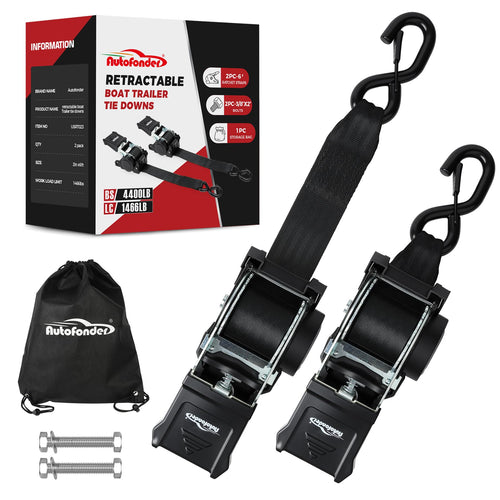
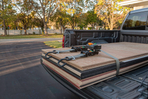
For most full-size pickup beds, 10-foot retractable ratchet straps are the right length: a strap hooked near one bed rail and anchored across a load that is 5.5 to 6.5 feet wide leaves just enough webbing to tension properly. A 2-inch × 10-foot pair rated at 1,466 lb working load limit per strap covers nearly every bed-cargo scenario.
Key Takeaways
- 10 feet is the sweet spot for full-size beds; 12 feet suits taller, bulkier loads.
- A 2-inch strap gives you 1,466 lb WLL versus 500 lb on 1-inch webbing.
- Under 49 CFR 393.106(d), total strap WLL should be at least half the cargo weight.
- Retractable housings need straight pull lines — sharp angles waste usable length.
- Skip retractables for loads taller than the cab or heavier than your straps' combined WLL.
Why Does Strap Length Matter More in a Pickup Bed?
On an open trailer you can route a strap almost anywhere. In a pickup bed, your anchor points are fixed: stake pockets, bed cleats, or tie-down rings mounted along the rails. The distance between an anchor and the far side of your cargo is usually 4 to 7 feet. A strap that is too short cannot reach across the load; one that is too long leaves extra webbing to vibrate and fray.
Retractable ratchet straps add a second constraint: the housing itself takes up about 6 to 8 inches of the strap's total length, and the take-up spool stores the slack. Unlike a standard strap, you cannot pull extra webbing through to wrap around an awkward anchor. What the housing holds is all you get. That is why length selection matters more for retractable tie down straps than for any other style — the 10-foot Autofonder 2-inch model is engineered so that roughly 8.5 feet of usable webbing spans a typical full-size bed crossing, with the rest absorbed by the take-up mechanism.
What Size Retractable Ratchet Straps Fit Different Beds and Loads?
Use this decision table before you buy. Every number comes straight from the product specifications — no guessing.
| Your question | 1 in × 12 ft (4-pack) | 2 in × 10 ft (2-pack) | 1 in × 15 ft self-storing |
|---|---|---|---|
| How much can each strap hold? | 500 lb WLL (1,500 lb break strength) | 1,466 lb WLL (4,400 lb break strength) | 500 lb WLL (1,500 lb break strength) |
| What cargo is it for? | Coolers, chairs, ladders, bundles of lumber | ATVs, UTVs, appliances, toolboxes, heavy furniture | Moving boxes, appliances, mixed small loads |
| Which bed does it fit? | Mid-size and full-size beds | Full-size beds and larger | Any bed; extra length wraps tall cargo |
| How many come in a pack? | 4 straps | 2 straps | 4 straps |
| What does it cost? | $79.99 | $69.99 | $49.99 |
The pattern is simple.

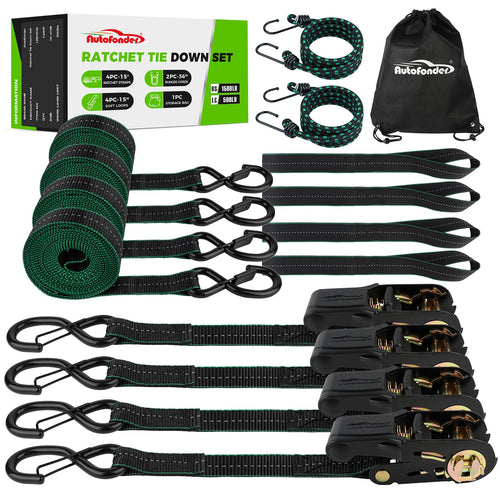
If your load is heavy enough that one strap must contribute serious holding power — an ATV, a loaded toolbox, a refrigerator — the 2-inch × 10-foot retractable ratchet tie-down straps are the correct answer, and 10 feet is the correct length. If you are securing many small, light items at once, the 1-inch × 12-foot four-pack gives you more anchor points for the same job. The 15-foot self-storing NeatStrap sits in between: longer webbing for tall or awkward cargo, with a Chromoly S-hook on each end.
How Many Retractable Ratchet Straps Do You Need for a Bed Load?
Two rules work together. The first is count-based: an unblocked article longer than 5 feet needs at least two tie-downs under 49 CFR 393.110(b). The second is strength-based: 49 CFR 393.106(d) requires the aggregate working load limit of your straps to be at least one-half the weight of the cargo. A strap that runs from a bed-rail anchor, over the cargo, and down to an anchor on the opposite rail counts at its full WLL — that is the strongest routing in a pickup bed.
Here is the math for a real load. A 1,200-pound UTV rolled into the bed needs at least 600 lb of aggregate WLL. Two 2-inch retractable ratchet straps crossed rail to rail deliver 2,932 lb of aggregate WLL — nearly five times the minimum, which is exactly the margin you want for highway bumps and hard braking. The same UTV on four 1-inch straps also clears the number (2,000 lb aggregate), but the 2-inch pair has wider webbing that spreads pressure across the tires instead of cutting into them.
When Should You Not Use Retractable Ratchet Straps in a Truck Bed?
Retractable tie downs have honest limits, and pretending otherwise gets cargo damaged. Do not use them when your load is taller than the cab — a strap routed over the top has no anchor above it, and a 10-foot strap will not wrap down both sides of a stacked load with room to tension. Do not use them for loads that exceed your straps' combined WLL, and do not use them when the only anchor points force a sharp side angle; the housing needs a straight pull line, and a strap dragged hard against a stake-pocket edge will abrade — add edge protection where webbing crosses a sharp corner, as FMCSA rules require for commercial loads. Finally, if you need to join two straps to reach around oversized cargo, retractables cannot do that; a standard ratchet strap is the right tool. Commercial flatbed operators should verify the assembly-rated WLL against 393.106(d) and step up to standard 2-inch or 4-inch ratchet straps or winch straps instead of consumer retractables.
How Do You Anchor 10-Foot Retractable Ratchet Straps Without Scratching the Bed?
Three habits protect both your bed and your straps. First, hook into factory anchor points — stake pockets, OE cleats, or bolt-in D-rings — rather than clamping onto bare rail edges. Second, match the hook to the anchor: S-hooks drop into stake pockets, while the soft loops on the 1-inch × 12-foot four-pack wrap around bars and rails without touching paint at all. Third, tension until the cargo stops moving when you push it — not until the webbing creaks. Retractable ratchet straps reach proper tension faster than standard straps because the mechanism multiplies your pull, so two or three strokes usually hold a 1,000-pound load firmly. Check the straps again after the first 50 miles of a long trip; commercial drivers must re-inspect within 50 miles, then every 3 hours or 150 miles — a habit worth copying.

Bottom Line: Which Length Should You Buy?
Buy the Autofonder 2-inch × 10-foot retractable ratchet tie-down straps — $69.99 for a 2-pack with 1,466 lb WLL per strap — if you haul ATVs, appliances, or anything over 1,000 pounds in a full-size bed. Add the 1-inch × 12-foot four-pack at $79.99 for lighter, multi-item loads that need more anchor points. That combination covers every pickup-bed job a homeowner or weekend hauler will realistically face. For a deeper safety breakdown of bed hauling, read is it safe to haul a pickup bed load with only retractable ratchet straps, and for cold-season care, see our winter maintenance guide.
FAQ
Will retractable ratchet straps scratch my truck bed or rails?
They should not, if the hooks land on designated anchor points instead of bare painted edges. Soft-loop versions never touch paint because the nylon loop wraps around the anchor. Keep grit out of the hook throat before each use — a trapped pebble dragged across a rail is the most common cause of scratches, not the strap itself.
Can retractable ratchet straps come loose on the highway?
A properly tensioned ratchet mechanism cannot back off on its own — the pawl locks each increment of tension. Straps come loose for three preventable reasons: the cargo settles and shrinks, an anchor flexes, or the hook was never fully seated. Re-check tension after the first 50 miles and the problem effectively disappears.
Are 10-foot retractable straps long enough for a bed with a tonneau cover or bed extender?
With a hard tonneau cover you typically strap inside the bed, so 10 feet still works. A bed extender adds 2 feet of effective length and taller anchor geometry, which is where the 1-inch × 12-foot or 15-foot models earn their keep. Measure anchor to cargo top before you order anything shorter than 12 feet.
Can I leave retractable ratchet straps mounted in my bed anchors between trips?
You can leave them stored in the bed, but release the tension and stow the straps in their housings. A strap left under constant tension for weeks fatigues the webbing fibers at the pressure points. UV exposure also degrades polyester over time, so garage storage between trips roughly doubles strap life.
Do I still need to check the straps during a long drive?
Yes. Vibration, rain, and cargo settling all loosen any tie-down gradually. The commercial standard — re-inspect within the first 50 miles, then at every 3 hours or 150 miles — exists because strap tension drops most in the first hour of driving. A 30-second walk-around at every fuel stop is enough for consumer hauling.
How do retractable ratchet straps compare with standard ratchet straps for bed cargo?
Retractable models trade peak WLL for speed and tidiness: the 2-inch Autofonder pair holds 1,466 lb per strap versus roughly 3,333 lb for a comparable standard 2-inch strap, but it self-stows and never tangles. For consumer pickup-bed loads under about 2,900 pounds, the retractable pair is the more practical tool — see our UTV retraction troubleshooting guide for long-term care.