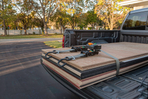
No — on the highway, bungee cords fail the federal math. A 1/4-inch bungee breaks near 300 lb but carries a working load limit of roughly 24 to 60 lb, far below the one-half-weight aggregate WLL that 49 CFR 393.106(d) requires. Use bungees for tarps and light bundling; use ratchet straps for anything that can shift or fall.
Key takeaways
- No federal rule names bungee cords, but 393.106(d) requires tiedown aggregate WLL of at least 50% of cargo weight — elastic cords cannot meet it.
- Typical 1/4-inch bungee: about 300 lb break strength but only 24–60 lb WLL; a 3/8-inch cord manages 32–80 lb WLL.
- Elastic cords store rebound energy; when one hook fails, the cord whips back at face level.
- Bungee hooks are the weak link — most failures happen at the hook-to-cord joint, not the rubber core.
- A $20 set of 1-inch ratchet straps (500 lb WLL each) outperforms a dozen bungee cords by more than 20 to 1.
Are Bungee Cords Legal for Securing Cargo on the Highway?
The law never says "no bungee cords." Instead, 49 CFR 393.106(d) says the aggregate working load limit of your tiedowns must equal at least one-half the weight of the cargo being secured. For commercial vehicles, an unsecured or under-secured load is an out-of-service condition under the CVSA North American Standard Out-of-Service Criteria.
Here is why bungee cords almost always fail that test. Under 393.108, an unmarked synthetic cordage tiedown is scored at the table value for polypropylene rope — one of the lowest ratings in the regulation. Even a generous reading using manufacturer data puts a 1/4-inch bungee at 24 to 60 lb WLL. Secure a 900 lb ATV and you need 450 lb of aggregate WLL: four bungees deliver at most 240 lb, less if their hooks are counted, because 393.108 rates an assembly at its weakest component. On a pickup hauling personal goods, state laws mostly mirror the same principle — the load must not shift, drop, or escape.
How Much Weight Can a Bungee Cord Actually Hold?
Far less than most drivers assume. Bungee strength is set by the rubber core diameter, and the working load limit is a small fraction of break strength because elastic cordage is dynamic — it stretches, rebounds, and fatigues.
| Cord or strap | Break strength | Working load limit | Elastic | Counts as a legal highway tiedown? |
|---|---|---|---|---|
| 1/4" bungee cord | ~300 lb | ~24–60 lb | Yes | No — cannot meet aggregate WLL |
| 3/8" bungee cord | ~400 lb | ~32–80 lb | Yes | No — same failure |
| 1" ratchet strap | 1,500 lb | 500 lb | No | Yes — with sewn WLL tag |
| 2" ratchet strap | 10,000 lb | 3,333 lb | No | Yes |
Two numbers explain the gap. First, manufacturers publish bungee working loads around 8–20% of break strength — a far thinner margin than the 3:1 factor WSTDA T-1 requires of web tie-down assemblies. Second, the steel hooks on consumer bungees are usually rated below the cord itself, and 393.108 counts whichever component is weakest.

Why Do Bungee Cords Fail at Highway Speed?
Three mechanical reasons. First, stretch: a bungee elongates up to 100–125% of its length, and each bounce over a pothole pumps more energy into it until the jacket abrades or a hook straightens. Second, the loads are bigger than drivers think — 49 CFR 393.102 assumes 0.8 g forward deceleration, 0.5 g rearward, and 0.5 g lateral. A 400 lb freezer braking from highway speed generates about 320 lb of forward force through its tiedowns.
Third, failure mode. A ratchet strap that fails goes slack; a bungee that fails snaps back. The stored elastic energy turns a stretched cord into a whip, and the freed end usually leaves through the tailgate with whatever it was holding. That is why professional haulers treat elastic cordage as a packaging tool, never as a tiedown — and why tiedown inspections at 50 miles, 3 hours, or 150 miles exist in the first place: everything loosens, but only an inelastic tiedown can simply be re-tightened.
When Can You Use Bungee Cords?
Bungee cords are legitimate tools — just not load-bearing ones. Use them for:
- Holding a tarp or tonneau cover down against wind
- Bundling rakes, extension cords, or garden hoses for storage
- Snugging a cooler lid or a sleeping bag inside a camp setup
- Temporary holds at walking pace on private property
The dividing line is consequence. If the item is light, surrounded by walls or a closed bed, and would only suffer scuffs if it slid, a bungee is fine. If the item could reach the roadway — a gas can, a toolbox, a kayak — it needs a rated tiedown. 393.104(f)(1) also prohibits knots in tiedowns, so a bungee knotted to shorten it is doubly wrong for real duty.

What Should You Use Instead of Bungee Cords?
Match the tool to the load, and do the 393.106(d) arithmetic before you leave the driveway:
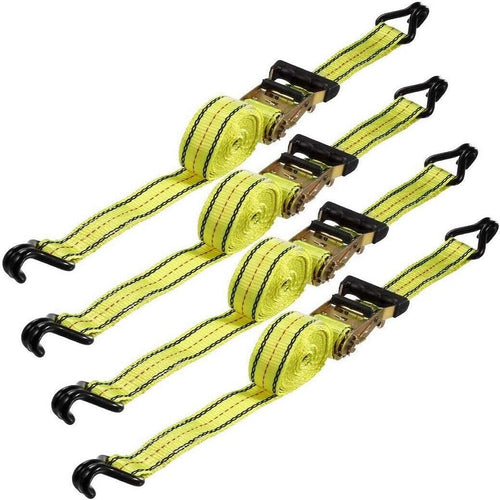
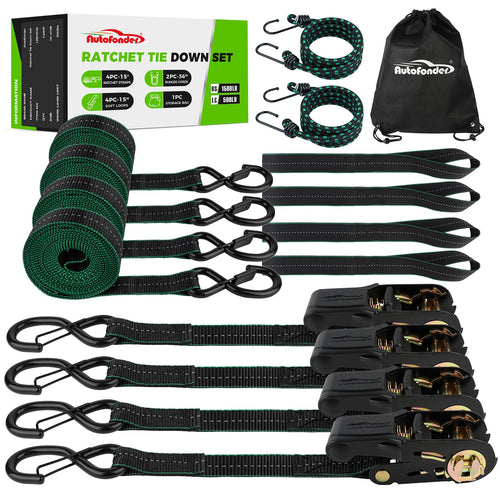
- Under 500 lb in a walled truck bed: two to four 1-inch ratchet straps. The Autofonder 1" x 15' ratchet tie-down 4-pack is rated 1,500 lb break / 500 lb WLL per strap — 2,000 lb aggregate, four times what a 900 lb load legally needs.
- Loose, awkward items (boxes, totes, firewood): add a cargo net. The Autofonder truck bed cargo net spans 50" x 66" with adjustable 2"-wide mesh and S-hooks, containing small items no single strap can reach. We compared the two approaches in cargo net vs ratchet straps for a truck bed.
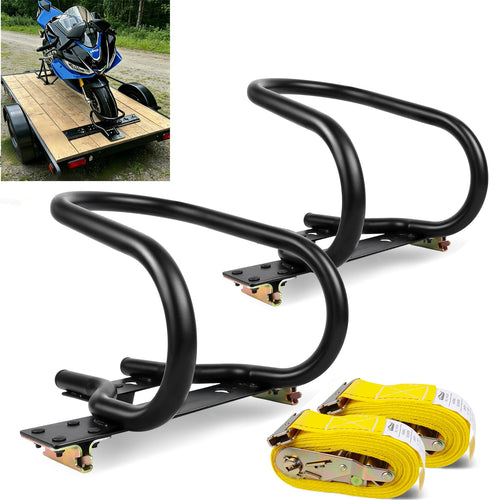
- Trailers and open beds: 2-inch ratchet straps hooked to real anchor points. Stake pocket D-rings rated 16,200 lb give the strap something honest to pull against — a bungee hooked to a rusted stake pocket is a decoration, not a tiedown.
How Many Ratchet Straps Does the Law Require?
Two rules stack. The aggregate WLL rule of 393.106(d) needs total tiedown capacity of at least half the cargo weight. The count rule of 393.110(b) requires at least one tiedown for an article up to 5 ft long and 1,100 lb or lighter, two tiedowns for anything 5–10 ft long regardless of weight, and one extra tiedown per additional 10 ft beyond that.
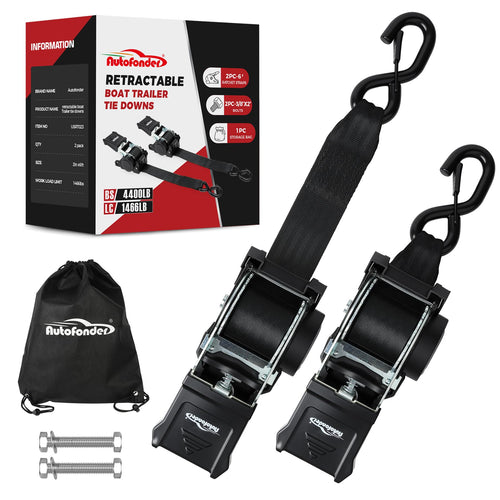
So a 6-ft, 300 lb sofa needs two tiedowns by count — and the same half-weight math by capacity. Four 1-inch ratchet straps at 500 lb WLL satisfy both for anything a pickup can carry. Inspect the whole system before every trip: CVSA out-of-service criteria include knots, more than 25% separated stitches, and cuts over 3/8 inch on 2-inch webbing. Our ratchet strap replacement checklist walks through all seven checks, and our retractable strap guide for ATVs covers self-storing options for quick light-duty loads.
Bottom Line: Are Bungee Cords Ever the Right Tool?
Bungee cords are the right tool for tarps and bundles, and the wrong tool for anything you would not want to lose at 65 mph. The numbers settle it: 24–60 lb of working load per cord against a legal minimum of half your cargo weight. For a few dollars more than a bungee multipack, a set of ratchet straps with sewn WLL tags — plus tie-down accessories like soft loops — delivers 500 lb of rated holding power per strap, holds tension for the whole trip, and keeps you on the right side of 393.106(d).
FAQ
Can I legally use bungee cords to secure a load in my pickup truck?
For personal loads, state laws generally require only that cargo cannot shift, drop, or blow out — so a bungee holding a tarp is fine. But any item capable of reaching the road should be on rated tiedowns. Commercial vehicles must satisfy 393.106(d) aggregate WLL, which bungee cords effectively cannot meet.
How much weight can a 1/4-inch bungee cord hold?
A typical 1/4-inch bungee breaks around 300 lb and carries a working load limit of roughly 24 to 60 lb, because elastic cordage uses a much thinner safety margin than woven straps. The hook is often the weakest part. Never treat break strength as holding capacity on a moving vehicle.
Why do bungee cord hooks bend or straighten?
Consumer bungee hooks are usually thin zinc-plated steel rated below the cord itself, and 393.108 counts the weakest component as the assembly rating. Under rebound shock — the snap-back when a stretched cord releases — the hook joint takes the full stored energy and deforms first, which is why failures happen at the hook, not the rubber core.
Are bungee cords better than ratchet straps for anything?
Yes, for non-structural jobs: holding tarps, bundling long items, quick camp setups, and anything where you want fast release and gentle, elastic tension. They are faster than a ratchet and cannot over-compress fragile cargo. They are simply not rated tiedowns and should never be the primary restraint on a highway load.
What is the cheapest legal way to secure cargo?
A 4-pack of 1-inch ratchet straps rated 1,500 lb break / 500 lb WLL per strap gives 2,000 lb of aggregate capacity — enough to satisfy the half-weight rule for any load a pickup can legally carry. Add a truck bed cargo net for small loose items, and inspect the webbing before every trip.