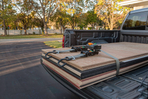
A frayed strap never announces itself until the load shifts. So when should you replace ratchet straps? Immediately if you find a knot, separated stitching, cracked hardware, or any cut, burn, or hole wider than 3/8 of an inch on 2-inch webbing — the CVSA out-of-service threshold — and re-check every strap 50 miles into each trip.
Key Takeaways
- Any knot, any size, disqualifies a strap — federal rules ban knots outright.
- Cuts, burns, or holes over 3/8 in. cumulative width retire a 2-inch strap.
- More than 25% separated stitches means the strap is out of service.
- A missing or unreadable WLL tag leaves a strap with no countable rating.
- Replace ratchet straps whenever fibers feel stiff, powdery, or UV-faded.
What Do FMCSA Rules Say About Damaged Ratchet Straps?
Federal cargo securement rules live in 49 CFR Part 393, Subpart I — written for commercial trucks, but the same physics applies to the strap holding a cooler in your pickup bed. Section 393.104 requires every tie-down, anchor, and buckle to be in proper working order, with no damaged or weakened component such as a crack or cut that would hurt performance. The same section states plainly that tie-downs must not contain knots, and that repairs must follow the manufacturer's instructions or the applicable standard — WSTDA-T1 for synthetic webbing.
Section 393.106(d) adds the math: the aggregate working load limit of your tie-downs must be at least one-half the weight of the cargo. A strap that is mechanically compromised cannot deliver its marked WLL, so it no longer counts toward that total. In short: if a strap's condition is in doubt, the regulation treats it as if it were not there — which is exactly when to replace ratchet straps.
Which Defects Put a Ratchet Strap Out of Service?
Knowing when to replace ratchet straps comes down to a short list of measurable thresholds. Roadside inspectors use the CVSA North American Standard Out-of-Service Criteria: synthetic webbing is defective if the working portion contains knots, more than 25% separated stitches, broken or damaged hardware, any repair or splice, overt damage, severe abrasion — or cumulative cuts, burns, and holes wider than 3/4 inch on 4-inch webbing, 5/8 inch on 3-inch webbing, or 3/8 inch on 2-inch webbing.
| Defect | The threshold | Action |
|---|---|---|
| Knot in webbing | Any knot, any size | Retire the strap |
| Cuts, burns, holes (2 in. webbing) | Over 3/8 in. cumulative width | Retire the strap |
| Cuts, burns, holes (4 in. webbing) | Over 3/4 in. cumulative width | Retire the strap |
| Separated stitching | More than 25% of stitches | Retire the strap |
| Ratchet or hook | Cracked, bent, or deformed | Retire the strap |
| WLL tag | Missing or unreadable | Replace — rating unverifiable |
| UV fading, stiff or powdery fibers | No fixed width threshold | Inspect closely; replace if fibers flake |
Run this table before every load — it takes a minute per strap, and it is the same checklist an inspector runs at a scale, so when to replace ratchet straps is never a judgment call.

Why Does a Missing WLL Tag Force You to Replace Ratchet Straps?
The working load limit tag is the strap's legal rating record. Under 393.104(e)(3), synthetic webbing tie-downs used on commercial vehicles must conform to WSTDA-T1, and conforming straps carry a permanent tag listing WLL, manufacturer, and webbing material. Inspectors look for that tag, not for stenciled printing on the webbing face.
If the tag is torn off or bleached illegible, the strap has no verifiable rating. Unrated 2-inch webbing defaults to just 2,000 lb WLL under the 393.108 tables, and your real aggregate may fall below the 50% cargo-weight minimum without you knowing it. That alone is a reason to replace ratchet straps that look fine but read blank — we covered how to read these numbers in our guide to decoding tie-down label ratings.
The rating of an assembly is also capped by its weakest component under 393.108(a) — a brand-new strap on a bent ratchet stem is rated by the bend, not by the webbing.
How Often Should You Inspect Your Straps?
Inspection is how you learn when to replace ratchet straps. Before every use, walk the full working length of each strap: webbing on both faces, stitching at the loop ends, the ratchet spindle and release lever, and both hooks. Run the webbing between your fingers — cuts and embedded glass shards often hide from the eye.
If you haul commercially, 49 CFR 392.9(b) requires the driver to examine the cargo and securement devices within the first 50 miles, then re-check every 3 hours or every 150 miles, whichever comes first. Vibration loosens ratchets — a smart habit for pickup owners too.

How Should You Store Ratchet Straps to Make Them Last?
Good storage delays the day you have to replace ratchet straps — sometimes by years. Ultraviolet light is the quiet killer: polyester loses strength with cumulative sun exposure, and a strap left coiled on a trailer deck ages far faster than one in a drawer. Moisture, road salt, and battery acid do the rest.
Three habits extend strap life measurably:
- Keep them out of the sun. Store straps in a cab, toolbox, garage, or storage bag between uses.
- Keep them clean and dry. Rinse off mud and salt, air-dry completely before stowing.
- Keep them wound, not stuffed. Loose webbing traps twists that become knots on the job site.
If you run flatbed gear, a steel strap winder bolts to the trailer and rolls each strap flat; a hook-and-loop wrap does the job for smaller straps.
Can You Repair a Damaged Ratchet Strap Instead?
When the damage is minor, deciding whether to repair or replace ratchet straps is a fair question. Section 393.104(f)(2) permits repairs only if they follow the manufacturer's instructions or the applicable standard, and CVSA treats any repair or splice in the working portion as a defect in itself. Field repairs fail twice in practice: sewn patches rarely match the factory's WSTDA-T1 stitch pattern, and every extra stitch row changes how load transfers through the webbing.
A replacement buckle sewn on by the original manufacturer is the only repair path with a paper trail — everything else is replacement territory, and a quality 2-inch strap costs a fraction of one cargo claim.
What Should You Buy When You Replace Ratchet Straps?
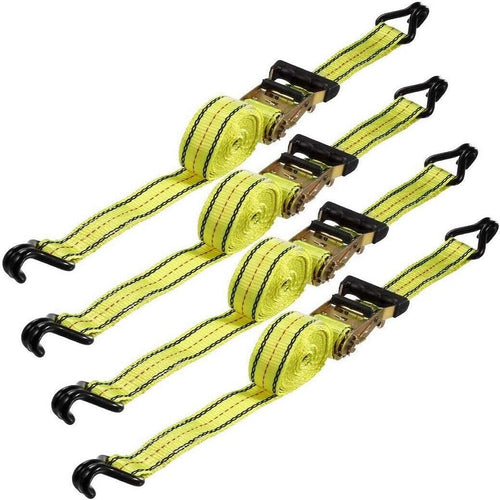
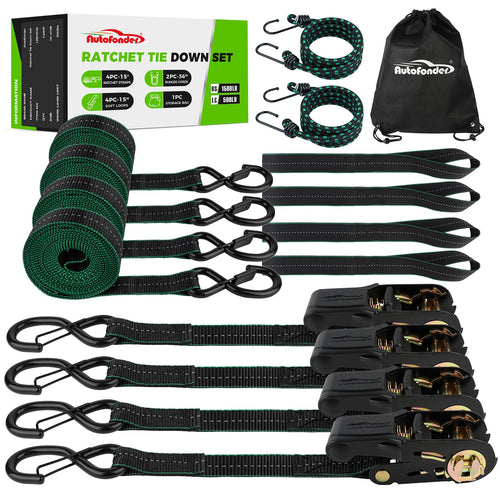
Match the strap to the job. For flatbed and trailer work, the Autofonder 2" x 27' Flat Hook Ratchet Straps deliver a 3,333 lb WLL backed by a 10,000 lb break strength, meeting the WSTDA-T1 3:1 design factor with margin. For appliances, ATVs, and lighter cargo, the 1.5" x 15' Ratchet Straps with coated double J-hooks carry a 1,000 lb WLL.
Browse the full ratchet strap collection or our cargo control accessories. If you are unsure how many straps your load requires, start with our breakdown of how much weight a 2-inch ratchet strap holds, and for ramp-and-trailer duty see how crews secure folding trailer ramps with retractable ratchet straps. A strap that lives on a trailer deck year-round takes the worst UV beating — keep a spare set.
FAQ
How long do ratchet straps last?
Federal rules tie service life to condition, not calendar age. A strap stored dry and shaded can serve for many seasons; the same strap left in the sun can degrade within a year. Inspect before every use and replace ratchet straps based on what you find, never on an anniversary date.
What size cut puts a 2-inch ratchet strap out of service?
Per CVSA criteria, cumulative cuts, burns, or holes wider than 3/8 inch put 2-inch webbing out of service — 5/8 inch applies to 3-inch webbing and 3/4 inch to 4-inch webbing. Defects add up across the working length, so two small nicks close together can cross the threshold on one strap.
Can I tie a knot in a strap to shorten it?
No. Section 393.104(f)(1) prohibits knots in tie-downs, and a knot can cut effective strap strength roughly in half. Shorten properly instead: roll excess webbing with a strap winder, or replace ratchet straps with the right length — 27 feet for flatbeds, 15 feet for truck beds.
How tight is too tight on a ratchet?
Crank until the strap is snug and the load cannot shift, then stop. Excessive tension concentrates force where the webbing bends over a cargo edge, accelerating hidden fiber damage, and it can distort light-duty hooks. Use edge protection under 393.104(f)(4) wherever a strap bears on a sharp or abrasive surface.
What WLL should my replacement straps have?
Synthetic webbing tie-downs follow a 3:1 design factor under WSTDA-T1, so a 2-inch strap with a 10,000 lb break strength is rated at 3,333 lb WLL. Total the WLL of all straps and confirm it meets at least 50% of your cargo weight per 393.106(d).
Bottom Line
Replace ratchet straps the day a strap fails the inspection table: any knot, over 25% separated stitches, damaged hardware, cumulative cuts wider than 3/8 inch on 2-inch webbing, or a missing WLL tag. Inspection takes a minute; a strap failure at highway speed costs far more. When you do retire a set, step up to Autofonder 2" x 27' flat hook ratchet straps with a full 3,333 lb WLL — and store the new set out of the sun.