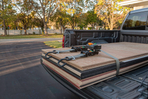
A 2-inch ratchet strap holds 3,333 lb of working load limit when the assembly is marked at 10,000 lb break strength, because WSTDA T-1 requires a 3:1 design factor. Unmarked 2-inch webbing drops to a federal default of 2,000 lb under 49 CFR 393.108 — 40% less capacity at the same width.
Key takeaways
- Working load limit equals break strength divided by 3, the WSTDA T-1 design factor.
- A marked 2-inch strap rates 3,333 lb WLL against 10,000 lb break strength.
- Unmarked 2-inch webbing is capped at 2,000 lb WLL by 49 CFR 393.108.
- FMCSA counts WLL, never break strength, in its 50% aggregate rule.
- One cut, knot, or broken stitch drops a strap to zero capacity.
What is the difference between working load limit and break strength?
Break strength is the load that destroys a strap in a lab. Working load limit is the load you are allowed to work it under, and it is always the smaller number.
For synthetic tie-downs, WSTDA T-1 sets a 3:1 design factor: WLL = break strength ÷ 3. So a 2-inch ratchet strap advertised at 10,000 lb break strength carries a 3,333 lb WLL. Under 49 CFR 393.108, the WLL of the whole assembly is the lowest WLL of any component — webbing, ratchet, hooks, or the anchor point it clips into.
That one rule explains most strap failures on the road. A 3,333 lb strap hooked to a 2,000 lb bed anchor is a 2,000 lb tie-down. Every ratchet strap in the Autofonder lineup ships with WLL and break strength on a sewn-in tag, the only figure FMCSA uses in a compliance calculation.

How much weight can a 2-inch ratchet strap hold at each width?
Width sets the ceiling. Wider webbing spreads tension across more polyester fibers, so a 4-inch assembly in the same construction carries roughly 60% more WLL than a 2-inch one.
| Polyester strap width | Typical marked WLL | Matching break strength | Federal WLL if unmarked (49 CFR 393.108) |
|---|---|---|---|
| 1 in | 500–1,000 lb | 1,500–3,000 lb | Below webbing table minimum |
| 1.5 in | 1,000 lb | 3,000 lb | Below webbing table minimum |
| 2 in | 3,333 lb | 10,000 lb | 2,000 lb |
| 3 in | 5,400 lb | 16,200 lb | 3,000 lb |
| 4 in | 5,400 lb | 16,200 lb | 4,000 lb |
The right-hand column is the trap. Unmarked webbing gets a default value from the regulation's own table — 2,000 lb for 2-inch webbing. A budget strap with a missing or unreadable tag cannot be counted at 3,333 lb.
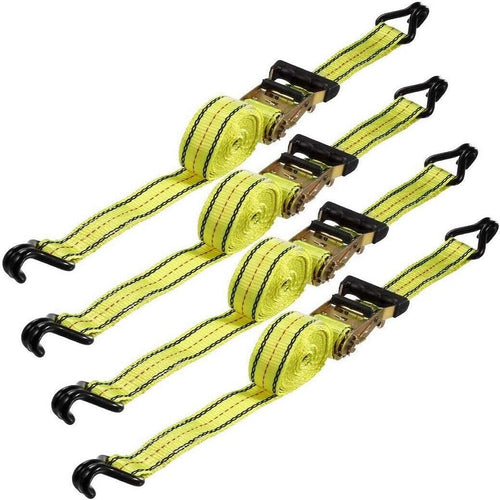
Two reference points worth memorizing: the Autofonder 2" x 27' flat hook ratchet straps are marked 3,333 lb WLL against 10,000 lb break strength, the certified figures for a 2-inch assembly. The 1.5" x 15' ratchet strap with coated double J hooks is marked 3,000 lb break strength, so its WLL lands at 1,000 lb.
Why is a 2-inch ratchet strap only as strong as its weakest component?
A strap is a chain of four rated parts: webbing, stitching, the ratchet tensioner, and the end fittings. 49 CFR 393.108(a) rates the assembly at the lowest of them — and at the anchor point too, if that is weaker.
Flat hook straps often beat their own webbing, because the stamped steel hook and the bar-tack stitching are rated above 10,000 lb. That is why the 3,333 lb WLL really does come from the 2-inch polyester webbing, and why a light anchor changes everything. A 4-pack of stake pocket D-rings is rated 16,200 lb each, which keeps the webbing as the limiting part. A generic 1,000 lb bed loop does not.
Two things silently delete capacity. Knots are prohibited outright in a tie-down, and a knotted strap has no calculable WLL. And any strap cut by a sharp edge is out of service — 49 CFR 393.104(f)(4) requires edge protection wherever webbing would be abraded or cut.
How much cargo can one 2-inch ratchet strap legally secure?
Under 49 CFR 393.106(d), the aggregate working load limit of your tie-downs must be at least half the weight of the cargo. Aggregate is not a plain sum, because routing changes what each strap is worth.
| How the strap runs | Counts toward aggregate WLL |
|---|---|
| Trailer anchor to a point on the cargo | 50% of marked WLL |
| Over the cargo and back to an anchor on the same side | 50% of marked WLL |
| From one side, over the cargo, to an anchor on the other side | 100% of marked WLL |
Run the math on a 6,000 lb load. Half of 6,000 is 3,000 lb of required aggregate WLL. Two 2-inch straps crossed side to side over the load contribute 2 × 3,333 = 6,666 lb, more than double the requirement. The same two straps run as direct corner ties contribute 2 × 1,666 = 3,333 lb, which still clears 3,000 lb but with 11% margin instead of 122%.
That is why four-point car hauling favors cross-strapping wherever the deck allows it. "One strap per ton" is not a rule — it is a calculation.
How many 2-inch ratchet straps do you need for your load?
Count and strength are two separate tests, and both must pass. 49 CFR 393.110 sets the minimum count for cargo that is not blocked against forward movement:
- 1 tie-down for articles 5 ft or less and 1,100 lb or less
- 2 tie-downs for articles longer than 5 ft up to 10 ft, at any weight
- 2 tie-downs for the first 10 ft, plus 1 more for every additional 10 ft or fraction of it
A pair of 2-inch straps covers a passenger vehicle up to 10 ft long, and 49 CFR 393.128 requires front and rear restraint on automobiles, light trucks, and vans up to 10,000 lb. For longer cargo, count the increments and round up — a 21 ft bundle needs four tie-downs, not two.
Then run the aggregate WLL test on top, because a heavy load often needs more straps than the length table demands. A 10-pack of 2" x 27' flat hook ratchet straps delivers the same 3,333 lb WLL per strap at a lower unit cost when a multi-point tie-down is the answer.
When should you step up to 3-inch or 4-inch straps?
Step up when the arithmetic demands it, not when the load looks big. A 4-inch winch strap rates 5,400 lb WLL against 16,200 lb break strength, so two of them cross-strapped deliver 10,800 lb of aggregate WLL — enough for a 21,600 lb article.
| Load weight | Aggregate WLL required | 2-inch straps (3,333 lb, direct) | 4-inch winch straps (5,400 lb, direct) |
|---|---|---|---|
| 4,000 lb | 2,000 lb | 2 straps = 3,333 lb | 1 strap = 2,700 lb |
| 6,000 lb | 3,000 lb | 2 straps = 3,333 lb | 2 straps = 5,400 lb |
| 12,000 lb | 6,000 lb | 4 straps = 6,666 lb | 3 straps = 8,100 lb |
| 20,000 lb | 10,000 lb | 6 straps = 9,999 lb, short | 4 straps = 10,800 lb |
Width also protects the cargo. Four-inch webbing spreads load over a wider footprint on lumber, pallets, and machinery, which reduces bruising and edge cutting. On a flatbed deck, 4" x 30' winch straps with flat hooks pair with a trailer-mounted winch so you can re-tension without fighting a ratchet handle, and the winch strap lineup covers 4-pack and 10-pack configurations.

FAQ
Is a 2-inch ratchet strap strong enough to hold a car?
Yes, for anything up to about 6,600 lb. Two direct corner ties at 3,333 lb WLL each deliver 3,333 lb of aggregate WLL, which clears the 50% requirement for a car that weight. For heavier vehicles or a three-point setup, match the hardware to the deck before you load.
What does 10,000 lb break strength mean on a 2-inch ratchet strap?
It means the assembly failed at 10,000 lb in a controlled pull test. That is a lab figure, not a working figure. Divide by the 3:1 design factor required by WSTDA T-1 and usable capacity is 3,333 lb. Inspectors calculate aggregate WLL from the marked number, never from break strength.
Can a 2-inch ratchet strap lose its rating in storage?
Yes. UV exposure, embedded grit, acid or alkali contact, and broken stitching all reduce capacity, and 49 CFR 393.104 requires tie-downs in proper working order. Inspect webbing and hardware before every load and retire any strap with cuts, knots, or an unreadable tag — unmarked 2-inch webbing falls to the 2,000 lb federal default.
Do you need edge protection with a 2-inch ratchet strap?
Whenever webbing touches a sharp corner or a rough edge, yes. 49 CFR 393.104(f)(4) requires protection that resists abrasion, cutting, and crushing at any contact point where the strap would be abraded. Wear sleeves, and add anchor hardware from the accessories range so webbing never rides on bare metal.
How tight should a 2-inch ratchet strap be?
Tight enough that the webbing runs straight and the ratchet handle closes past its lock point, never so tight that the webbing folds or the cargo crushes. Then re-check: 49 CFR 392.9(b) asks drivers to inspect the load within the first 50 miles and again at every change of duty status, 3 hours of driving, or 150 miles.
Bottom line: size the 2-inch ratchet strap to the load, not the packaging
A marked 2-inch ratchet strap holds 3,333 lb WLL — 10,000 lb break strength divided by three. Two of them cross-strapped give you 6,666 lb of aggregate WLL, enough for a 6,000 lb article under the 50% rule. Anything heavier belongs on wider webbing.
Match the marked WLL to the calculation, keep the tag readable, and protect the webbing at every edge. Start with the 2" x 27' flat hook ratchet straps for general use up to 6,000 lb, then move to the 4-inch winch strap range once your load passes 12,000 lb.