For most kayak haulers, 1-inch retractable ratchet straps with soft loops are the better choice: each strap carries a 1,500 lb break strength and 500 lb working load limit, tensions in seconds with no loose tail to flap at 65 mph, and self-stores after the trip. Pick a cam buckle only when you need feather-fine tension on a thin, flexible polyethylene hull.
Key Takeaways
- Ratchet mechanisms hold tension far better than cam-buckle friction.
- A 500 lb WLL retractable strap triples most cam buckles' holding power.
- Soft loops wrap crossbars without scratching paint or gelcoat.
- Retractable straps self-store — no tangled spaghetti in your garage bin.
- Cam buckles still win for ultra-light hulls and rental-fleet simplicity.
How Do the Two Mechanisms Actually Differ?
A cam buckle works by friction: you thread the webbing through a toothed plate, pull it tight, and the cam's spring pressure pinches the strap in place. Every bump, every gust, and every rain shower works against that pinch. A ratchet mechanism instead winds the webbing onto a spool and locks each increment with a pawl — the tension physically cannot unwind until you press the release.
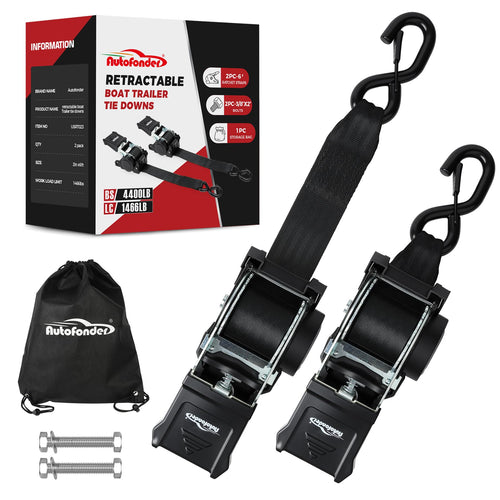
Retractable tie downs add a third element: a constant-force spring inside the housing that rolls the strap back up when you release it. The Autofonder NeatStrap with safety lock S-hooks pairs that self-storing housing with 1-inch webbing, a 1,500 lb break strength, and a 500 lb working load limit — the rating that matters, since WLL is break strength divided by a 3:1 design factor per industry convention. A typical 1-inch cam buckle strap offers no such margin story: its holding power depends entirely on how hard your arm can pull and how well friction cooperates that day.
Which Strap Holds a Kayak More Securely at Highway Speed?
Ratchet straps, and it is not close. A kayak weighing 40 to 80 pounds does not need enormous force to stay put, but it does need force that survives an hour of wind pressure at 65 mph. Cam buckle straps loosen measurably in the first hour of driving as the webbing stretches and the hull compresses — which is exactly why commercial drivers must re-inspect cargo within the first 50 miles, then every 3 hours or 150 miles under 49 CFR 392.9(b). That rule applies to commercial vehicles, but the physics it addresses apply to your roof rack too.
A ratchet strap reaches and holds its set tension because the pawl locks it there. Two retractable ratchet straps on a kayak, bow and stern lines included, deliver 1,000 lb of combined working load limit against a load one-twentieth that heavy. That margin absorbs the difference between a calm morning run to the lake and crosswinds on the interstate. If you are still choosing hardware for the hull itself, our boat trailer transom fit guide covers the 2-inch, short-strap option for trailer haulers.

Can a Ratchet Strap Crush a Plastic Kayak Hull?

It can, if you treat every strap like a torque wrench. Polyethylene hulls dent under concentrated pressure, and a ratchet's advantage — huge, stable tension — becomes a liability if you crank it to the max. The fix is technique, not a different strap: tension until the kayak stops sliding when you push it sideways, then stop. On a roof rack, route straps over the widest part of the hull or through the cockpit opening with padding, and use soft loops rather than bare metal hooks at the crossbars. The 15-foot length on the safety-lock NeatStrap gives you plenty of webbing to wrap a crossbar twice and pad the contact line. Done this way, retractable ratchet straps are no harsher on a hull than cam buckles — they are just more decisive, so discipline matters more.
Which One Is Faster and Cleaner After a Paddle Day?
The retractable design wins this round decisively. After a lake day, a cam buckle strap is a wet, sandy ribbon that has to be unthreaded, coiled, and rubber-banded — or dumped in a bin to become next month's knot problem. The retractable strap releases with one button press and rolls itself into its housing; the whole job takes seconds per strap, and the self-storing format means wet webbing never touches your trunk lining. Anglers who launch several times a week consistently rank storage as the number-one reason they switch. The one trade-off: sand inside the housing can slow retraction, so rinse straps with fresh water and air-dry them before storing — our winter maintenance guide covers the full care routine.
When Does a Cam Buckle Still Win?
Honest answer: in three situations. First, on ultra-thin or older polyethylene hulls where even moderate ratchet tension creates oil-canning dents and you lack padding — a cam buckle's gentle, arm-limited tension is genuinely safer there. Second, for rental fleets and family loaner gear, where every user already understands a cam buckle and a ratchet mechanism invites over-tensioning by novices. Third, when strap weight and packed size matter more than holding power, such as bike-packing or airline travel kits. Retractable ratchet straps also have fixed lengths — you cannot splice or rethread them — so if your anchor geometry demands custom wraps, a standard tie-down is the better tool. For heavy loads beyond the consumer class, step up to standard ratchet straps entirely; this comparison stays within kayak, canoe, and light-cargo territory.
Retractable vs Cam Buckle for Kayaks: The Head-to-Head
| Question | Retractable ratchet strap | Cam buckle strap |
|---|---|---|
| How well does it hold tension? | Pawl locks every increment — cannot back off | Friction only — loosens as webbing stretches |
| What is the typical WLL? | 500 lb per strap (1,500 lb break strength) | Far lower for the same 1-inch webbing |
| How fast is setup? | Seconds, one-handed | Slower — thread, pull, re-check |
| How is storage? | Self-storing housing, no tangles | Loose webbing to coil and band |
| Hull safety? | Excellent with soft loops and controlled tension | Gentler by default, but looser on the road |
| Best for? | Regular haulers, highway runs, two-kayak racks | Occasional short trips, delicate older hulls |
Bottom Line
Buy the Autofonder 1-inch × 15-foot retractable ratchet straps with soft loops and safety lock S-hooks — $37.99 for a 4-pack, 500 lb WLL per strap — and use two straps per kayak plus bow and stern lines. Keep one cam buckle pair in the garage for delicate, older hulls, and let the retractables handle every highway run.
FAQ
Will retractable ratchet straps scratch my kayak's hull?
Not the webbing itself — polyester strap is softer than the hull. Scratches come from metal hooks contacting gelcoat or from grit trapped under the strap. Use soft loops at every anchor point, keep the strap face clean, and add foam pads where webbing crosses the hull edge, and your polyethylene or composite hull stays scratch-free for years of trips. The same logic protects painted truck beds and boat hulls — we tested it directly in do retractable ratchet straps stain truck beds and boat hulls.
Can I drive at highway speed with retractable ratchet straps on a kayak?
Yes — that is where their locked pawl mechanism outperforms cam buckles. Two straps with a combined 1,000 lb WLL on an 80-pound kayak gives a 12:1 safety margin. Check tension after the first 50 miles of any long drive, mirror what commercial drivers are required to do, and add bow and stern lines so the hull cannot lift at speed.
How tight should retractable ratchet straps be on a kayak?
Tight enough that the kayak will not slide when you push it sideways — typically two to three ratchet strokes on a 1-inch strap. The hull should compress slightly but never visibly deform. If you see oil-canning dents where the strap crosses, back off a stroke and add padding under the webbing instead of pressure.
Do retractable ratchet straps work in the rain?
Yes. Polyester webbing loses no meaningful strength when wet, and the sealed ratchet mechanism is unaffected by rain. The real enemy is grit and road salt: rinse the straps in fresh water after coastal or winter driving, let them air-dry fully before retracting, and the housing will not corrode or jam.
Are soft loops better than S-hooks for roof racks?
For painted crossbars and hull contact, soft loops are clearly better — nylon wraps around the bar and never bares metal on paint. S-hooks earn their place on dedicated anchor points like tie-down rings and trailer rails. The safety-lock S-hook design on our NeatStrap keeps the hook captive so it cannot spring free over potholes, which matters most on trailer setups.
How many retractable ratchet straps does one kayak actually need?
Two across the hull at minimum, plus bow and stern lines for highway speeds. Our full breakdown in how many retractable ratchet straps to tie down a kayak covers two-kayak racks and trailer configurations in detail.