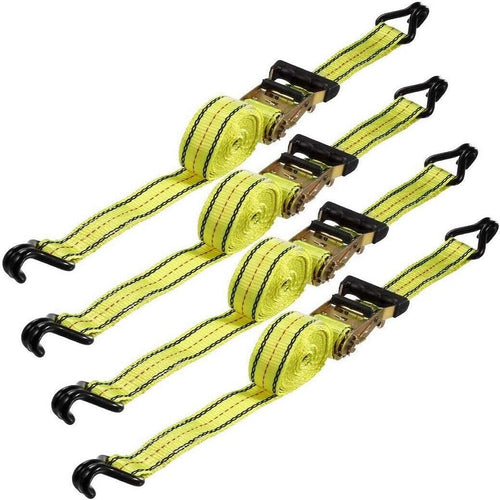
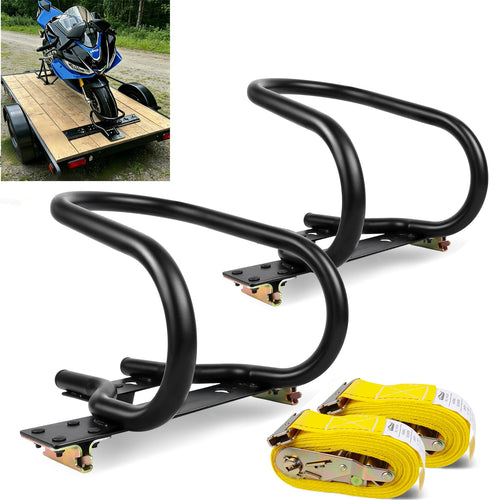
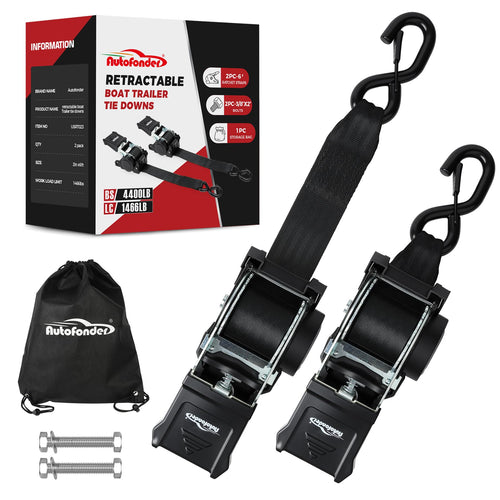
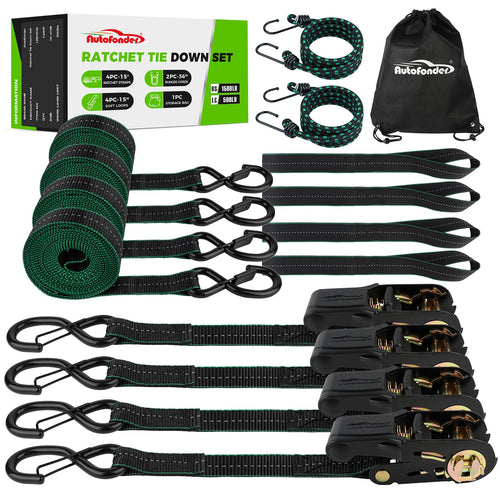
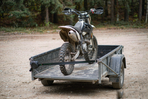
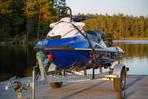
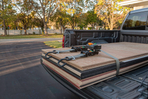
Tie down a golf cart with four straps, one at each wheel or axle corner, plus chocks against the tires. A typical electric cart weighs 900 to 1,200 lb, so four 2-inch straps at 3,333 lb WLL each give 6,666 lb of aggregate WLL — twelve times the 50% floor in 49 CFR 393.106(d).
Key Takeaways
- Four points, one per wheel or axle corner, is the working standard — better than the two-strap federal minimum.
- 49 CFR 393.110(b) requires only two tie-downs for a cart 5 ft to 10 ft long, so count is not your limit.
- 49 CFR 393.106(c)(1) requires chocks, wedges or a cradle to stop anything that can roll.
- Never rely on the parking brake, the roof canopy or one strap across the cart.
- Indirect tie-downs count at half value: 49 CFR 393.106(d)(1) and (d)(2).
How many tie-down straps does a golf cart need?
Four is the practical answer, and it is more than the law demands. 49 CFR 393.110(b) requires two tie-downs for any article longer than 5 ft and up to 10 ft, plus one more per 10 ft beyond. A two-seat cart measures 7.5 ft to 9.5 ft, so the federal minimum to tie down a golf cart is two straps.
Two straps keep a cart on the trailer but not square. With only two points, a cart can still rotate around the axis between them — yaw — on a hard turn or a pothole. Four straps, one at each corner, close that rotation off and cost only two extra straps. For the arithmetic, read how many tie-down straps it takes to secure a vehicle.

What is the correct way to tie down a golf cart on a trailer?
Work through it in this order.
- Position the cart. Center it over the trailer axles or slightly ahead, aiming for 60% of its weight forward of the axle.
- Chock the tires. 49 CFR 393.106(c)(1) requires anything likely to roll to be restrained by chocks, wedges or a cradle. A wheel chock tie-down kit rated 4,500 lb break strength chocks and straps in one step.
- Run four straps, one per corner. Feed webbing through the wheel or around the axle, then anchor to a deck ring or E-track. Autofonder's 2" x 36" axle straps with D-rings are rated 3,333 lb WLL and wrap a cart axle without touching brake cables.
- Cross the rear pair. Running the two rear straps in an X stops side-to-side walk. A tire tie-down strap with snap hook anchors fast to a deck ring.
- Tension, then re-check. Tighten until there is no slack and the suspension compresses slightly, then stop — cranking a ratchet until it will not move deforms hardware. Re-check after 50 miles, per 49 CFR 392.9(b).
Should you strap the wheels, the axles, or the frame?
| Attachment point | Load path | Verdict |
|---|---|---|
| Tires or wheels | Webbing wraps the tire; load stays low | Best for carts — no suspension travel, no body damage |
| Axles | Webbing loops the axle tube | Good, if you clear brake cables, fuel lines and the motor harness |
| Frame rails | Webbing pulls down on the body | Risky — dents sheet metal and compresses the suspension |
Either of the first two is defensible. Autofonder's car tie-down collection is built around that low, wheel-level load path, as are E-track tire straps if your trailer has E-track.
Why is strapping the frame usually the wrong move?
Because it looks stronger and is usually weaker. Two reasons.
The first is sheet metal. On most modern carts the frame sits under a plastic or stamped-steel body, and a 2" strap under tension across a rocker panel dents it. A strap that slips off a smooth painted panel goes slack, and a slack strap stops carrying load — which quietly changes your aggregate WLL.
The second is suspension. Strapping the frame compresses it, so the body moves relative to the trailer and tension changes with every bump. Looping the wheel or axle captures the unsprung weight and holds tension far more stably — which is why it is easier to tie down a golf cart at the tires than at the body panels.
Run the webbing straight. 49 CFR 393.104(f)(1) prohibits knots, and a knotted strap is treated as an unrated device at roadside inspection.
What do you do with the roof and windshield?
Nothing structural is holding that canopy on. A cart roof is typically a 4 ft to 6 ft molded panel on four thin posts, and above roughly 55 mph it behaves like a sail, generating lift instead of downforce. Towing at 60 to 65 mph loads it hard enough to crack the rear posts.
You have three options. Remove the canopy and windshield for the haul. Fold or lower the windshield on carts that support it. Or, if it must stay, run a dedicated strap over the canopy — never through it — anchored to the deck. That strap is in addition to your four wheel straps, and never replaces the 2" x 27' ratchet straps doing the real work.
How do the FMCSA numbers work for a 900 to 1,200 lb cart?
Run the two tests FMCSA applies and a golf cart passes easily — but the math explains why four points, not two, is the right habit for how you tie down a golf cart.
Aggregate WLL. Under 49 CFR 393.106(d) your tie-downs must add up to at least half the cargo weight, so a 1,100 lb cart sets a 550 lb floor. Full WLL counts for a strap that crosses the load to the opposite side; half WLL counts for a strap that runs vehicle anchor to cargo anchor or returns to the same side. Four straps at 3,333 lb WLL each, rigged indirectly, total 6,666 lb.
Performance criteria. 49 CFR 393.102 requires the system to resist 0.8 g forward, 0.5 g rearward and 0.5 g laterally — for a 1,100 lb cart, about 880 lb forward and 550 lb sideways. Four straps clear it with margin; two handle the fore-aft case and leave the lateral case to your chocks.
If you haul commercially, the CVSA North American Standard Out-of-Service Criteria let an inspector place the vehicle out of service for too few tie-downs, too little aggregate WLL, or a damaged device.

Frequently asked questions
Is it legal to haul a golf cart on a trailer?
Yes, if the load meets Subpart I of 49 CFR Part 393. Commercial haulers need at least two tie-downs for a cart over 5 ft long, aggregate tie-down WLL of at least half the cart's weight, and chocks against any wheel that can roll.
Can you tie down a golf cart with only two straps?
Legally, often yes — 49 CFR 393.110(b)(2)(ii) sets two tie-downs for anything 5 ft to 10 ft long. Practically, two straps leave the cart free to yaw under braking and cornering. Add a second pair at the rear wheels and rotation stops.
Do you have to remove the golf cart roof before towing?
You do not have to, but protect it. A canopy is a 4 ft to 6 ft molded panel that generates lift above roughly 55 mph. Removing it is safest, and if the roof stays on, add a strap over it. Never let the canopy be your only tie-down point.
What is the best strap for tying down a golf cart?
A 2-inch strap rated 3,333 lb WLL, rigged through the wheels or around the axles. Wheel and axle straps with D-rings are easiest because they wrap a tire or axle tube without touching body panels. Add chocks so rolling is restrained separately from sliding.
Can you haul a golf cart on a utility trailer?
Yes, if the trailer is long enough to center the cart over its axle. A 10 ft utility trailer handles a two-seat cart; a 12 ft deck is more comfortable. To tie down a golf cart on a utility trailer, strap the wheels, chock the tires, and confirm the trailer's load rating exceeds the cart weight.
Bottom Line
To tie down a golf cart safely, use four straps at the wheels or axles and chock both sides — that combination beats the two-strap federal minimum on yaw control and costs almost nothing. Autofonder's wheel chock tie-down kit handles chocking and strapping in one piece of hardware, and 2" x 36" axle straps rated 3,333 lb WLL each wrap a cart axle cleanly. Handle the roof separately and re-check tension after the first 50 miles.