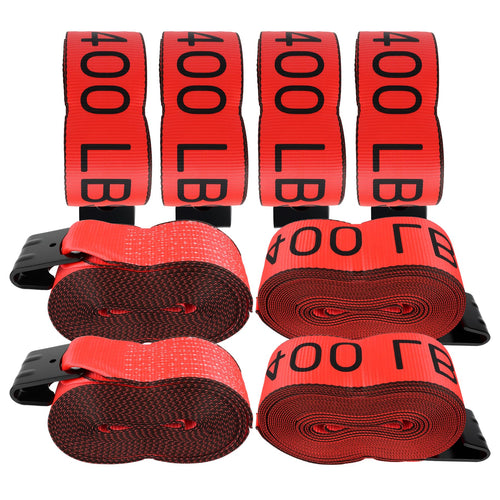
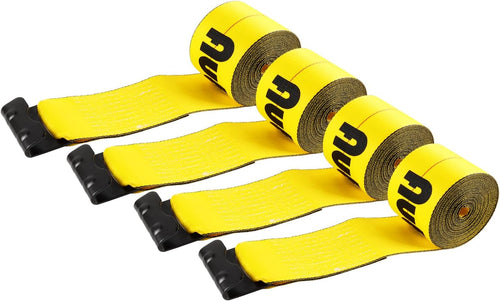
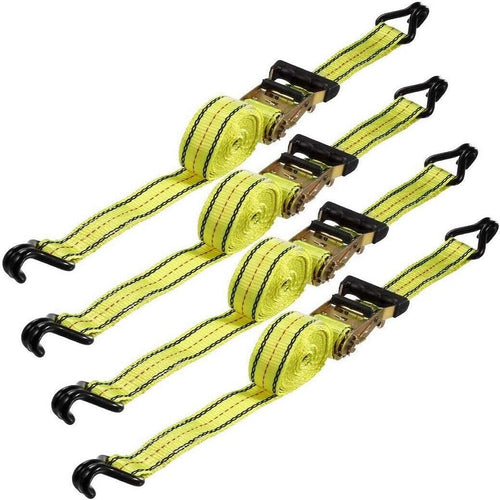
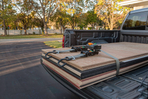
Winch straps and ratchet straps secure cargo in different ways. A 4-inch winch strap carries a 5,400 lb working load limit (WLL) and is tensioned by the trailer's winch drum. A 2-inch ratchet strap carries 3,333 lb WLL from its own ratchet. Choose winch straps for long deck loads, ratchet straps for everything else.
Key Takeaways
- Winch straps run from a winch drum to a fixed anchor; ratchet straps carry their own handle.
- A 4" x 30' winch strap is rated 5,400 lb WLL against 16,200 lb break strength.
- A 2" x 27' ratchet strap is rated 3,333 lb WLL against 10,000 lb break strength.
- 49 CFR 393.106(d) requires aggregate WLL of at least half the cargo weight.
- Indirect runs count at half value; opposite-side runs count at full value.
What is a winch strap, and how does it work on a flatbed trailer?
A winch strap is a length of polyester webbing with a flat hook sewn onto one end and a plain tapered end on the other. You feed the tapered end into the trailer's winch drum, crank the drum, and the webbing tightens across the deck. The flat hook catches the rub rail on the far side.
Because the drum does the tensioning, the assembly has no ratchet, no handle and almost no bulk — which is why these straps are built long. 4" x 30' is the standard flatbed size, and Autofonder's 4" x 30' flat hook winch straps are rated 5,400 lb WLL and 16,200 lb break strength, a 3:1 design factor and the same ratio WSTDA T-1 applies to synthetic webbing.
The limit is usually the anchor. 49 CFR 393.108(a) defines a tiedown's WLL as the lowest WLL of any component or the anchor's rating, whichever is lower. A 5,400 lb assembly landed on a 2,000 lb stake pocket is a 2,000 lb tiedown.

How is a ratchet strap different?
A ratchet strap carries its own tensioner. Handle, pawl and geared spindle are built into the assembly, so one person can tension it in seconds with no trailer hardware at all. Autofonder's 2" x 27' flat hook ratchet straps are rated 3,333 lb WLL and 10,000 lb break strength.
That self-contained design is why ratchet straps dominate on pickups, utility trailers and box trucks, where no drum exists. It also explains the rating gap: a 2" strap has half the webbing width of a 4" strap, so its working load limit lands near 62% of the wider assembly. To add capacity, step up in width — see the winch strap collection and the ratchet strap collection.
Winch straps vs ratchet straps: how do the specs compare?
| Spec | Winch strap, 4" x 30' | Ratchet strap, 2" x 27' |
|---|---|---|
| Working load limit | 5,400 lb | 3,333 lb |
| Break strength | 16,200 lb | 10,000 lb |
| Tensioned by | Trailer winch drum | Built-in ratchet handle |
| Webbing width | 4 in | 2 in |
| Typical job | Long deck loads, step decks, lumber, pipe | Pickups, enclosed trailers, equipment |
Both designs are legal under Subpart I of 49 CFR Part 393 as long as each assembly is marked with its WLL and stays serviceable. 49 CFR 393.104(f)(1) adds the condition that matters most in the field: tiedowns must not contain knots, and a knotted strap is treated as a damaged device.
Which setup gives you more holding power per dollar?
Holding power is math, not branding. Under 49 CFR 393.106(d), the aggregate working load limit of your tie-downs must be at least half the weight of the cargo. Add half the WLL for each strap running from a vehicle anchor to a cargo anchor, half for each strap that passes over the load and returns to the same side, and full WLL for each strap that crosses to the opposite side.
For a 10,000 lb load you need 5,000 lb of aggregate. Two 4" assemblies crossing the deck to the opposite rail count at full value: 10,800 lb. Four 2" ratchet straps run the same way count 13,332 lb. Both pass; the first uses two devices, the second uses devices you can carry to any trailer you own.
Cost follows the same split. A 10-pack of 4" x 30' flat hook winch straps covers a whole flatbed on one drum, which is why fleets standardize. Smaller assemblies, like the 1.5" x 15' ratchet straps with double J hooks rated 1,000 lb WLL, cost less per strap and move between vehicles.
When should you choose each one?
Choose the drum-fed option when the load is long, flat and deck-level. Lumber, pipe, steel and stacked pallets want a continuous run of webbing from the drum to the far rail, with no ratchet body in the middle of the deck. With no ratchet in the assembly you can run more of them along one drum, and they lie flatter. Autofonder's winch strap line covers 4" widths in 4-packs and 10-packs for that reason.
Choose ratchet straps when no drum exists: pickup beds, utility trailers, enclosed trailers and one-off flatbed jobs. Pick them for short loads, unevenly spaced anchors or awkward tensioning angles, where a built-in handle reaches what a drum cannot. They travel well too — a 2" x 27' strap coils into a bag and works on any vehicle. For anything wider than 2", check the ratchet strap collection first.
How do you keep either setup compliant with FMCSA rules?
Three numbers decide compliance, whichever type you pick.
Count. 49 CFR 393.110(b) sets the minimum number of tie-downs by article length: two for anything longer than 5 ft and up to 10 ft, then one more per additional 10 ft or fraction. Count and WLL rules are enforced independently — a strong aggregate number never excuses a missing strap.
Condition. The CVSA North American Standard Out-of-Service Criteria treat a knotted, cut or abraded tiedown as no tiedown at all, which can drop your aggregate below the 50% floor and put the vehicle out of service. Inspect webbing for cuts, abrasion, heat damage and distorted hardware before every trip.
Edge protection. 49 CFR 393.104(f)(4) requires edge protection wherever a tiedown touches cargo at a point where it could be abraded or cut, so sleeve your webbing on steel, angle iron or concrete forms. Autofonder's cargo control accessories cover the sleeves that keep a rated strap rated.

Frequently asked questions
Can you use a winch strap without a winch?
No. A winch strap has no tensioner, so it cannot be tightened by hand. Without a drum to crank it, the webbing stays slack and the load moves. If you need similar capacity without a winch, use a ratchet assembly rated for the load instead.
Are winch straps stronger than ratchet straps?
Per strap, usually yes — but the reason is width, not the tensioning method. The 4" x 30' winch strap is rated 5,400 lb WLL while the 2" x 27' ratchet strap is rated 3,333 lb WLL. A 4" ratchet assembly and a 4" winch assembly carry similar ratings.
How many winch straps do you need for a 20-foot load?
At least three under 49 CFR 393.110(b)(3), and their combined WLL still has to reach half the cargo weight. A 12,000 lb load needs 6,000 lb of aggregate, so three 5,400 lb straps run to the opposite rail clear it with room to spare.
Do you need edge protection with winch straps?
Yes, wherever the webbing crosses a sharp edge. 49 CFR 393.104(f)(4) requires edge protection at any point where a tiedown could be abraded or cut by the cargo. Steel beams, channel iron and concrete forms are the classic offenders.
Can you repair a winch strap?
A cut or frayed webbing strap should be replaced, not patched. 49 CFR 393.104(f)(2) allows repair only in line with the manufacturer's instructions, and field repairs rarely qualify. Once webbing is cut, its rated working load limit is void.
Bottom Line
If you run a flatbed with a drum and haul long deck-level loads, standardize on this type: two 4-inch assemblies give you 10,800 lb of aggregate WLL and cover a 20-foot deck with no ratchet body in the load path. Autofonder's 4" x 30' winch straps are rated 5,400 lb WLL against 16,200 lb break strength. If you haul mixed loads with no drum, 2" x 27' ratchet straps are the more flexible answer.