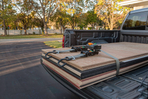
Tie down a skid steer with four independent restraint points, one at each corner, anchored as close as practicable to the front and rear. Under 49 CFR 393.130, any wheeled or tracked machine of 10,000 lb or more needs a minimum of four tie-downs, and their aggregate working load limit must reach at least half the machine's weight.
Key takeaways
- Four tie-downs minimum at 10,000 lb or more, one per corner, per 49 CFR 393.130.
- Aggregate working load limit must reach 50% of the machine's weight.
- A direct trailer-to-machine strap counts at only half its marked WLL.
- Lower the bucket, secure the boom, and pin any articulation before you strap.
- Re-check tension within the first 50 miles and again every 3 hours of driving.
How many tie-downs does a skid steer need?
The answer depends on weight. 49 CFR 393.130 applies to wheeled or tracked vehicles, equipment, and machinery that individually weigh 4,536 kg (10,000 lb) or more, and it fixes a hard floor: a minimum of four tiedowns, restraining the machine against lateral, forward, rearward, and vertical movement.
Machines under 10,000 lb may be secured under 393.130, under 393.128, or under the general cargo rules in 393.100 through 393.114. Under those general rules, a 6,500 lb machine longer than 5 ft needs two tie-downs by count. In practice, most haulers still run four points on sub-10,000 lb machines, because a machine that pivots on the deck can walk a two-point tie loose.
Note what 393.130 does not do: unlike general cargo, it does not add a tie-down for every extra 10 ft of machine length. Four is the fixed minimum, and the working load limit calculation is where heavier machines push you to add more.

How much working load limit do you need for the machine's weight?
Two tests apply, and both must pass. The count test is the four-tie-down minimum above. The strength test comes from 49 CFR 393.106(d): the aggregate working load limit of all tie-downs must be at least half the weight of the machine.
The trap is how each strap is counted. A tiedown running from a trailer anchor directly to a point on the machine contributes only 50% of its marked WLL. A tiedown that crosses over the machine and anchors to the opposite side of the trailer contributes 100%.
| Machine weight | Minimum tie-downs | Aggregate WLL required | 4 direct 4" winch straps (5,400 lb WLL) | Same 4 straps, cross-strapped |
|---|---|---|---|---|
| 6,500 lb | 2 (general rules) | 3,250 lb | 10,800 lb | 21,600 lb |
| 7,500 lb | 2 (general rules) | 3,750 lb | 10,800 lb | 21,600 lb |
| 10,000 lb | 4 (393.130) | 5,000 lb | 10,800 lb | 21,600 lb |
| 12,000 lb | 4 (393.130) | 6,000 lb | 10,800 lb | 21,600 lb |
| 20,000 lb | 4 (393.130) | 10,000 lb | 10,800 lb | 21,600 lb |
Even with direct corner ties, four marked 5,400 lb straps deliver 10,800 lb of aggregate WLL — enough for a 20,000 lb machine on paper, though a machine that heavy usually calls for chain. Tie down a skid steer of 12,000 lb and the same four straps still carry 1.8 times the requirement. For a typical 7,500 lb machine, the four-point strap setup carries nearly three times the margin.
Where do you attach tie-downs on a skid steer or compact track loader?
49 CFR 393.130(c)(2) requires each tiedown to be affixed as close as practicable to the front and rear of the vehicle, or to mounting points specifically designed for that purpose. Most manufacturers cast or weld dedicated tie-down lugs on the frame — use those first.
Hooking the wrong place is expensive. Avoid hydraulic cylinders, axles, hoses, and anything that moves, because a strap that loads a cylinder rod can bend it under a 0.8 g braking event. On the trailer side, 49 CFR 393.108(a) rates the whole tiedown at its weakest component, including the anchor point. A stake pocket D-ring set rated 16,200 lb each will never be the limiting part of a strap assembly.
Also protect the webbing. 49 CFR 393.104(f)(4) requires edge protection wherever a tiedown would be abraded or cut, and steel machine frames are full of sharp edges. Route straps so they contact a rounded frame member, or add a sleeve.
Should you chain or strap a skid steer down?
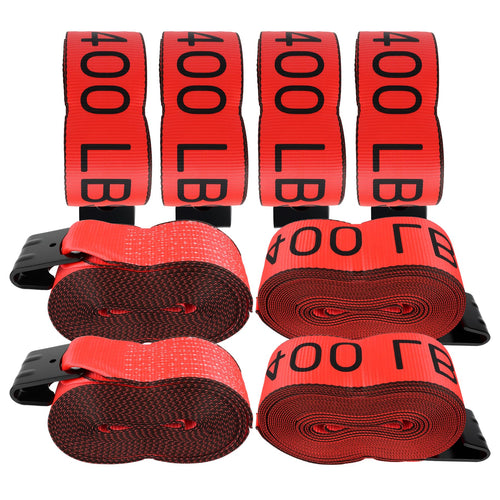
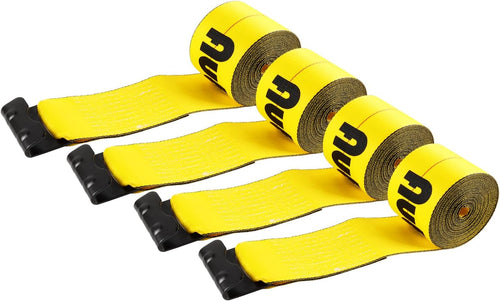
Chains are the traditional answer, and for machines at 20,000 lb and above they usually still are. Both are legal ways to tie down a skid steer — the marked WLL decides. Marked synthetic webbing is fully compliant, and a 4" x 30' winch strap rated 5,400 lb WLL against 16,200 lb break strength comfortably clears the aggregate WLL math for any skid steer in the 6,500 to 12,000 lb range.
The marked number is what counts. Unmarked 4-inch webbing is assigned a federal default of 4,000 lb under the 49 CFR 393.108 tables, which is still enough for four direct ties on a 15,000 lb machine — but a strap with no tag cannot be counted at its real capacity at all.
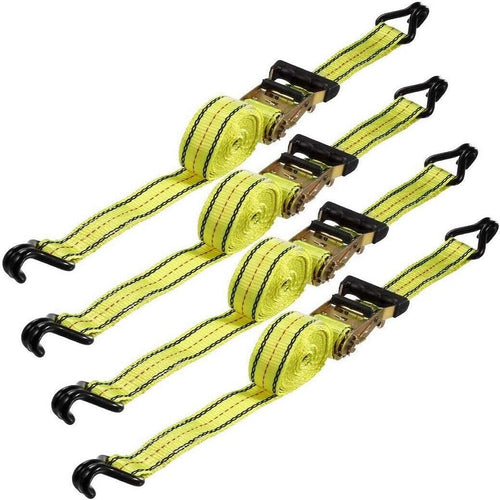
Straps also win on the re-tensioning loop. A trailer-mounted winch lets you re-crank a strap in seconds without leaving the deck, and the winch strap lineup comes in 4-pack and 10-pack configurations. For smaller machines, a 2" x 27' flat hook ratchet strap at 3,333 lb WLL handles attachments and implements.

What else has to be secured besides the four corners?
Three things, and they are all in the regulation. 49 CFR 393.130(b)(1) requires accessory equipment such as hydraulic shovels to be completely lowered and secured to the vehicle — a skid steer bucket rides flat on the deck, in the air. 49 CFR 393.130(b)(2) requires articulated machines to be restrained so they cannot articulate in transit.
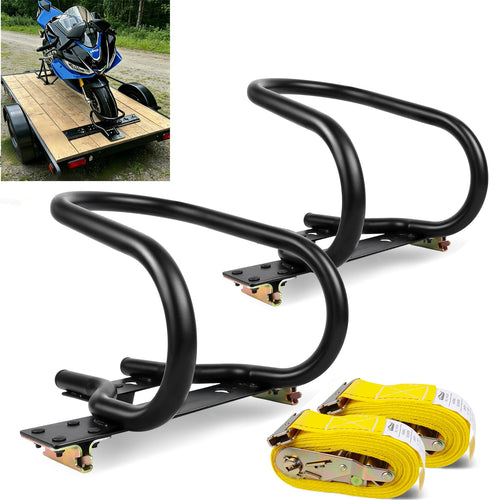
Set the parking brake, and strap loose items separately. A spare bucket, forks, or a breaker attachment each need their own restraint; a 2-inch ratchet strap at 3,333 lb WLL is usually adequate for attachments in the 1,000 to 4,000 lb class. Anything likely to roll also needs chocks, wedges, or a cradle.
How do you re-check the load after you pull out?
49 CFR 392.9(b) builds three checkpoints into every trip: before driving, within the first 50 miles, and then at whichever comes first — a change of duty status, 3 hours of driving, or 150 miles. Tracks and tires settle, deck boards flex, and webbing relaxes a few percent on its first heat cycle.
At each stop, walk the machine. Look for slack in any of the four legs, webbing rubbing on a frame edge, a hook that has walked off its lug, and the bucket still resting where you left it. Re-tension, then re-check after the next few miles. Behind those checkpoints sits 49 CFR 393.102: the securement system has to resist 0.8 g of forward deceleration, and 0.5 g rearward and laterally. Slack is what turns those numbers into movement.
Bottom line: how to tie down a skid steer in four moves
To tie down a skid steer correctly: place four tie-downs, one at each corner, as close to the front and rear as the frame allows; confirm the aggregate WLL reaches half the machine's weight, counting direct straps at half value; lower and secure the bucket and every attachment; and re-check within the first 50 miles.
For a 6,500 to 12,000 lb machine, four 4" x 30' winch straps with flat hooks at 5,400 lb WLL give you more than double the required margin, with 16,200 lb anchors available from the stake pocket D-ring range. Chain the day you cross 20,000 lb.
FAQ
How many tie-downs does a skid steer under 10,000 lb need?
Two by count under the general rules, since 393.130 only mandates four at 10,000 lb and above. Most haulers still run four points, because a two-point tie lets a tracked machine pivot and walk. Run the aggregate WLL math either way, because count alone does not prove compliance.
Can you use straps instead of chains to tie down a skid steer?
Yes, as long as the webbing carries a marked WLL that satisfies 49 CFR 393.106(d). A 4-inch winch strap marked 5,400 lb WLL provides 2,700 lb per direct tie, so four of them deliver 10,800 lb of aggregate WLL. Chains still dominate above roughly 20,000 lb, where strap count and deck space start to work against you.
Do you count the full WLL of every strap toward the total?
No. A direct tie from a trailer anchor to the machine counts at half its marked WLL under 49 CFR 393.106(d). Only a strap that passes over the machine and anchors on the opposite side of the trailer counts at full value. Four direct 5,400 lb straps contribute 10,800 lb, not 21,600 lb.
Where should you never hook a tie-down on a skid steer?
Never hook hydraulic cylinders, hoses, axles, or any component that moves under load — a strap that loads a cylinder rod can bend it during a 0.8 g braking event. Use the manufacturer's designated tie-down points where they exist, or the frame rails. And never route webbing over a sharp edge without protection under 49 CFR 393.104(f)(4).
Do you tie down a skid steer by the tracks or the frame?
By the frame, whenever the machine has rated points there. Wrapping tracks or tires is permitted equipment practice, but a strap over a track can loosen as the undercarriage sheds mud, and 393.130(c)(2) asks for attachment points near the front and rear of the vehicle. Frame lugs near each corner satisfy that requirement directly.